Get 5% Off – Use promo code German Attire


How to Measure for Lederhosen? Get the Right Fit Every Time
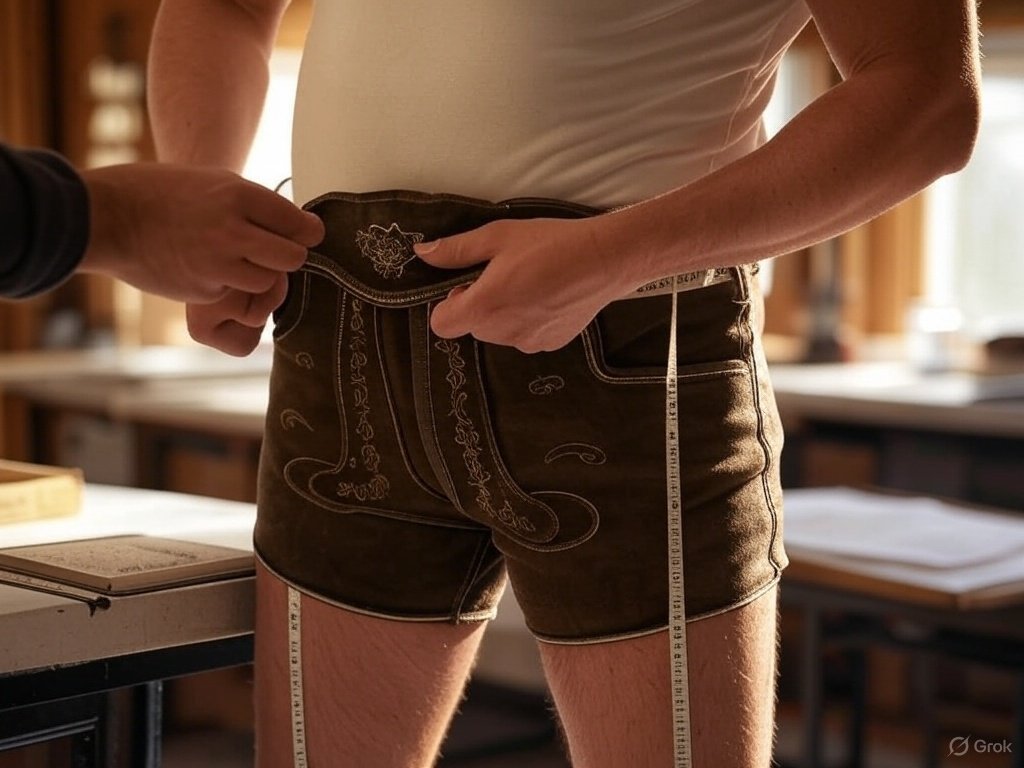
How to Measure for Lederhosen: The Complete Step-by-Step Guide
Getting the right measurements for Lederhosen is where most people stumble—and it’s the single most important factor in whether your purchase succeeds or ends up as an expensive mistake.
We’ve helped hundreds of customers take measurements, and we’ve seen the same errors repeated over and over. People measure themselves with jeans on. People measure at their hip bones instead of their natural waist. People confuse their jeans inseam with their Lederhosen inseam. And then they’re disappointed when their carefully chosen pair arrives and doesn’t fit.
This guide is different. We’ll walk you through exactly how to measure yourself for Lederhosen, using the same methods and standards we use when fitting customers in person. We’ll show you where to measure, why it matters, what the measurements mean, and how to avoid the most common mistakes.
By the end, you’ll have accurate measurements and the confidence to order the perfect size—the first time.
Why Measuring Yourself Matters More Than You Think
You might be tempted to just look at your jeans size and order the equivalent Lederhosen size. Don’t do this.
Jeans are cut differently than Lederhosen. Your jeans likely sit on your hips, 2-3 inches below your natural waist. Lederhosen sit at or above your natural waist. This alone can mean a 1-2 size difference.
Beyond that, Lederhosen are made from natural leather—not stretchy cotton blends. They don’t adapt to a slightly-loose fit the way modern trousers do. If you order based on how you want them to fit, rather than how your body actually measures, you’ll either be uncomfortable or they’ll fit badly.
Taking accurate measurements takes 10 minutes. Dealing with returns, exchanges, or wearing ill-fitting Lederhosen all season takes weeks and costs money. Do the measurements.
Tools You’ll Need: Setting Yourself Up for Success
Before you measure, gather these essential tools. Having everything ready ensures accuracy and prevents frustration.
A Soft, Flexible Measuring Tape
This is non-negotiable. You need a soft, fabric measuring tape—the kind used in sewing or tailoring. These are typically 60 inches (150 cm) long and cost just a few pounds.
Why soft tape? Metal measuring tapes (like the ones used in construction) can’t wrap smoothly around your body. They’ll give inaccurate readings, and the rigidity makes it hard to get a true measurement of curves. Fabric tapes conform to your shape and give you the actual circumference you need.
Pro tip: Make sure your tape has clear, easy-to-read centimeter markings. Lederhosen sizes use the metric system, and switching between inches and centimeters is where mistakes happen.
Light, Form-Fitting Clothing
Wear something that won’t add bulk to your measurements. Ideally, thin underwear or lightweight leggings/tights. Avoid:
- Thick sweaters or jumpers
- Baggy jeans or tracksuits
- Belts or waistbands that compress your natural waist
- Thick socks when measuring legs
Think of it this way: you’re measuring your actual body, not your body plus winter clothes.
A Notepad or Your Phone
Write down measurements immediately after taking them. Don’t trust your memory. Even small errors (78 cm vs. 88 cm) change everything.
Label each measurement clearly as you take it:
- Waist: ____ cm
- Hip: ____ cm
- Thigh: ____ cm
- Knee Cuff: ____ cm
- Back Length: ____ cm
A Mirror (Helpful But Not Essential)
A full-length mirror helps you confirm you’re at the right measuring points and that your tape is sitting level. This is especially useful when self-measuring areas like the waist.
A Friend (Highly Recommended for Accuracy)
Some measurements are nearly impossible to take accurately by yourself. Specifically:
- The back length (from waist to knee)
- Ensuring the tape is level all the way around
- Checking that you’re measuring at the correct height
A friend makes this significantly easier and more accurate. If possible, ask someone to help you for 15 minutes.
The Five Essential Measurements
You need exactly five measurements to find your perfect Lederhosen size. We’ll cover each in detail, explaining not just how to measure, but why each measurement matters.
Measurement 1: Waist (The Most Important)
Your waist measurement is your primary size indicator for Lederhosen.
Where to Measure
Find your natural waist—this is the narrowest part of your torso, usually right at or just above your belly button. This is NOT where your jeans waistband sits. Jeans typically sit 2-3 inches lower on the hips.
To find your natural waist:
- Stand in front of a mirror in light clothing
- Place your hand on the narrowest part of your torso (usually about level with your belly button)
- This is your natural waist
How to Measure
- Wrap your soft measuring tape around your natural waist
- Keep the tape snug but NOT tight—you should be able to fit one finger comfortably underneath
- Stand naturally (don’t suck in your stomach or slouch)
- Read the measurement where the tape overlaps
- Record the number in centimeters
Common mistakes:
- Measuring at your hip bones instead of natural waist (adds 2-4 cm, size is too large)
- Sucking in your stomach (removes 2-5 cm, size is too small)
- Measuring over thick clothing (adds 1-3 cm, size is too large)
Why This Measurement Matters
Traditional Lederhosen are designed to sit at the natural waist. This high placement is part of their authentic design and what gives them their distinctive silhouette. If you measure at your hip bones and get a larger waist measurement, you’ll order a size too large, and the Lederhosen will sag and shift around.
Real-world example: A customer came in saying their 34″ jeans required a German size 48 Lederhosen. When we measured their actual natural waist (not jeans waist), they measured 86 cm—right in the middle of size 50. The size 48 would have been too small at the waist.
Interpreting Your Waist Measurement
Based on your waist measurement in centimeters, here’s where you fall in the size range:
- 70-73 cm → Size 42 (XXXS)
- 74-77 cm → Size 44 (XXS)
- 78-81 cm → Size 46 (XS)
- 82-85 cm → Size 48 (S)
- 86-89 cm → Size 50 (M)
- 90-94 cm → Size 52 (L)
- 95-99 cm → Size 54 (XL)
- 100-104 cm → Size 56 (2XL)
- 105-109 cm → Size 58 (3XL)
Important: Your waist measurement gives you a starting point, but your hip and thigh measurements might move you up or down a size. Keep reading.
Measurement 2: Hips (Often Overlooked, But Critical)
Many people skip this measurement, and it’s a mistake. Your hip circumference determines whether the Lederhosen will feel comfortable when you sit, stand, or move.
Where to Measure
Stand with your feet hip-width apart. Your hip measurement is around the fullest part of your hips and buttocks. For most people, this is 7-9 inches (about 20 cm) below your natural waist.
To find the right spot:
- Identify your waist (from Measurement 1)
- Measure down about 20 cm (8 inches)
- This is typically where the fullest part of your hips and seat is located
How to Measure
- Wrap your tape around the fullest part of your hips and buttocks
- Keep it level (it should be at the same height all the way around your body)
- Keep tension consistent—snug but not tight
- Read and record the measurement
Pro tip: Have a friend help ensure the tape is level, especially at the back.
Why This Measurement Matters
Lederhosen hug the hips. If your hip measurement is significantly larger than your waist measurement, you might need to size up from what your waist alone suggests. If your hips are too tight, the Lederhosen will restrict movement and be uncomfortable to sit in.
Understanding Your Hip Measurement
Compare your hip measurement to your waist:
- Difference of 4-5 inches or less: Your size is straightforward based on waist measurement
- Difference of 5+ inches: You may need to size up by one size to accommodate hip room
- Very large difference (8+ inches): Definitely size up; prioritize hip comfort over a tight waist
Real-world example: A customer had an 82 cm waist (size 48) but a 104 cm hip measurement (size 56 territory). He ordered size 48 based on waist alone, and the hips felt restrictively snug. He exchanged for size 50, and while the waist was slightly loose (solved with suspender adjustment), the hips fit comfortably.
Measurement 3: Thigh (For Athletic Builds, This Is Crucial)
The thigh measurement determines whether your Lederhosen will feel comfortable during movement or uncomfortably tight.
Where to Measure
Stand with your feet hip-width apart. Measure around the thickest part of your thigh, typically 4-6 inches (10-15 cm) below the hip.
To find the right spot:
- Place your hand on the thickest part of your thigh (usually mid-thigh)
- This is where you’ll measure
How to Measure
- Wrap your tape around the thickest part of your thigh
- Keep it snug but not tight
- Ensure the tape is level all the way around
- Record the measurement
Why This Measurement Matters
If you have muscular legs or an athletic build, your thigh measurement might suggest a larger size than your waist measurement indicates. Ignoring this is a common mistake—customers order based on waist alone, receive the Lederhosen, and find the thighs uncomfortably snug.
Important: Thigh fit issues don’t resolve with wear. Unlike the waist, which loosens slightly with break-in, thigh tightness that’s there on day one will still be there in month two. If the thighs are uncomfortably tight, you need a larger size.
Understanding Your Thigh Measurement
- Thigh 48-50 cm: Fits comfortably in size 42-44
- Thigh 51-52 cm: Fits comfortably in size 46-48
- Thigh 52.5-53.5 cm: Fits comfortably in size 48-50
- Thigh 54-55 cm: Fits comfortably in size 50-52
- Thigh 55.5-56.5 cm: Fits comfortably in size 52-54
- Thigh 57-58 cm: Fits comfortably in size 54-56
- Thigh 58.5-59.5 cm: Fits comfortably in size 56-58
- Thigh 60+ cm: Fits comfortably in size 58+
Decision rule: If your thigh measurement suggests a larger size than your waist measurement, size up.
Measurement 4: Knee Cuff (Often Forgotten, Creates Problems)
The knee cuff is where the leg opening of your Lederhosen will sit. Getting this wrong means either struggling to put them on or having a baggy leg opening.
Where to Measure
Measure around your knee—the entire circumference at the widest part of your knee.
How to Measure (Important Detail)
Here’s where most people go wrong: measure your knee while wearing the socks you’ll actually wear with Lederhosen.
Lederhosen are traditionally worn with thick, knee-high Bavarian wool socks. These socks add significant bulk—often 0.5-1 cm to your knee circumference. If you measure your bare knee and order based on that, the Lederhosen leg opening might be uncomfortably tight when you wear them with socks.
- Put on knee-high socks (similar thickness to traditional Bavarian socks)
- Measure around your knee (the widest part)
- Keep the tape snug but not tight
- Record the measurement
Why This Measurement Matters
If the leg opening is too tight, you’ll struggle to put the Lederhosen on and take them off. If it’s too loose, they’ll look baggy and won’t stay in place when you move or dance.
Understanding Your Knee Cuff Measurement
- 36 cm: Size 42
- 37 cm: Size 44
- 38 cm: Size 46
- 39 cm: Size 48
- 40 cm: Size 50
- 41 cm: Size 52
- 42 cm: Size 54
- 43 cm: Size 56
- 44 cm: Size 58
Pro tip: If your knee measurement falls between sizes, go with the slightly larger option. You can always adjust with thicker or thinner socks, but you can’t make a too-tight leg opening looser.
Measurement 5: Back Length (Determines If You’ll Look Proportional)
The back length determines where your Lederhosen will hit on your legs—whether they’ll be knee-length, mid-thigh, or somewhere in between.
Where to Measure
The back length is measured from the base of your spine (at waist level) down to just below your knee for traditional Lederhosen, or mid-thigh for shorter modern styles.
How to Measure
This is one measurement where a friend is genuinely helpful:
- Stand barefoot in front of a mirror
- Have your friend (or do it yourself with a mirror) place the measuring tape at the top of your buttocks where the waistband of your Lederhosen will sit
- Measure straight down the back of your leg
- For traditional knee-length Lederhosen, measure to just below the knee
- For shorter modern Lederhosen, measure to mid-thigh
- Record the measurement
Self-measurement method: If you’re alone, stand against a wall, place a hand level with where your waistband will sit, and measure down your leg to where you want the Lederhosen to end.
Why This Measurement Matters
Lederhosen that hit at the wrong length look awkward and feel uncomfortable. The traditional length hits just below the knee and is paired with knee-high socks—it’s part of the authentic Alpine look. Modern shorter versions hit mid-thigh for a contemporary style.
If your back length measurement is off, the Lederhosen either drag or ride up uncomfortably.
Understanding Your Back Length Measurement
Our sizing chart uses these back length measurements:
- 50 cm: Size 42
- 50.2 cm: Size 44
- 51 cm: Size 46
- 51.7 cm: Size 48
- 52.5 cm: Size 50
- 53.7 cm: Size 52
- 54.7 cm: Size 54
- 55.7 cm: Size 56
- 56.7 cm: Size 58
Important note: Back length doesn’t determine your overall size—it’s checked against your size to confirm it’s proportional. A size 50 Lederhosen has a specific back length (52.5 cm). If you’re a size 50 but your back length is unusually long or short, you might need custom tailoring.
Compiling Your Measurements: What They Mean Together
Now you have five measurements. But what do they mean together? Here’s where we put it all together.
Creating Your Measurement Profile
Write out all five:
- Waist: ______ cm
- Hip: ______ cm
- Thigh: ______ cm
- Knee Cuff: ______ cm
- Back Length: ______ cm
Finding Your Size Using Our Chart
| German Size | Inter Size | Waist (CM) | Hip (CM) | Thigh (CM) | Knee Cuff (CM) | Back Length (CM) |
| 42 | XXXS | 70-73 | 86-89 | 48-49 | 36 | 50 |
| 44 | XXS | 74-77 | 90-93 | 49.5-50.5 | 37 | 50.2 |
| 46 | XS | 78-81 | 94-97 | 51-52 | 38 | 51 |
| 48 | S | 82-85 | 98-101 | 52.5-53.5 | 39 | 51.7 |
| 50 | M | 86-89 | 102-105 | 54-55 | 40 | 52.5 |
| 52 | L | 90-94 | 106-109 | 55.5-56.5 | 41 | 53.7 |
| 54 | XL | 95-99 | 110-113 | 57-58 | 42 | 54.7 |
| 56 | 2XL | 100-104 | 114-117 | 58.5-59.5 | 43 | 55.7 |
| 58 | 3XL | 105-109 | 118-121 | 60-61 | 44 | 56.7 |
Example 1 – Slim Build:
- Waist: 87 cm (size 50)
- Hip: 104 cm (size 50)
- Thigh: 54.5 cm (size 50)
- Knee Cuff: 40 cm (size 50)
- Back Length: 52.5 cm (size 50)
Decision: Size 50. All measurements align perfectly.
Example 2 – Athletic Build:
- Waist: 85 cm (size 48)
- Hip: 104 cm (size 56)
- Thigh: 57 cm (size 54)
- Knee Cuff: 41 cm (size 52)
- Back Length: 52 cm (size 50)
Decision: Size 52. Your waist suggests size 48, but your thigh (57 cm) and hip (104 cm) suggest larger. Size 52 splits the difference. The waist will be slightly loose initially but will tighten with leather break-in and suspender adjustment.
Example 3 – Larger Build:
- Waist: 102 cm (size 56)
- Hip: 116 cm (size 56)
- Thigh: 59 cm (size 56)
- Knee Cuff: 43 cm (size 56)
- Back Length: 55.7 cm (size 56)
Decision: Size 56. All measurements consistently point to size 56.
The Hierarchy: Which Measurement Matters Most?
If you have conflicting measurements, prioritize in this order:
- Thigh — Most important. Tight thighs don’t improve with break-in. If thigh suggests a larger size, size up.
- Hip — Second most important. Tight hips restrict movement and sitting.
- Waist — Third. Waist fit is adjustable via suspenders and leather break-in.
- Knee Cuff — Less critical. Foot thickness in socks is adjustable.
- Back Length — Used to confirm proportions for your size. Alterations are possible if drastically different.
Common Measurement Mistakes (And How to Avoid Them)
We’ve seen these errors repeatedly. Learn from others’ mistakes.
Mistake 1: Measuring at Your Hip Bones Instead of Natural Waist
The problem: Your jeans sit on your hip bones. Lederhosen don’t. If you measure at hip bones, you’ll get a measurement 2-3 inches larger than your actual natural waist, and you’ll order a size too large.
How to verify: Find your natural waist. It’s the narrowest part of your torso. It’s usually 2-3 inches higher than where your jeans sit. Measure there, not at the hip bones.
Mistake 2: Measuring Yourself with Clothes On
The problem: Thick clothing adds centimeters you don’t actually have. A sweater can add 2-3 cm to your waist measurement.
How to verify: Measure in light, form-fitting clothing. You should feel the tape against your body, not against thick fabric.
Mistake 3: Measuring Your Jeans Instead of Your Body
The problem: Your jeans are cut differently than Lederhosen. They’re loose in some areas, snug in others. Your jeans size doesn’t translate directly to Lederhosen size.
How to verify: Measure your actual body, not your clothing. A 34″ jeans waist might be 86 cm of actual body, or 90 cm, depending on the brand and fit.
Mistake 4: Forgetting to Measure with Socks On (For Knee Cuff)
The problem: Bavarian wool socks are thick. If you measure your bare knee and order based on that, the leg opening will be uncomfortably tight when you wear the socks you actually plan to wear.
How to verify: When measuring knee cuff, put on knee-high socks similar to what you’ll wear with Lederhosen.
Mistake 5: Sucking In Your Stomach
The problem: If you measure while holding your breath or sucking in, you’ll get a smaller waist measurement than reality. When you wear the Lederhosen normally, they’ll be too tight.
How to verify: Measure in your normal standing posture. Don’t suck in or slouch. Stand as you normally would wearing clothing.
Mistake 6: Confusing Inseam (Jeans) with Back Length (Lederhosen)
The problem: Jeans inseam is measured from crotch to ankle. Lederhosen back length is measured from the waistband (which sits higher) to below the knee. These are different measurements.
How to verify: For Lederhosen, measure from where the waistband will sit (natural waist, not hip) down to just below your knee. This is your back length.
Still Unsure About Your Measurements?
If you’ve taken your measurements and you’re still uncertain, don’t guess. Contact us before ordering. We can:
- Verify your measurements against our sizing chart
- Advise on sizing between sizes based on your body type
- Recommend material based on your preferences and fit goals
- Discuss break-in expectations
Visit our collection at germanattire.co.uk/shop/ or reach out with your measurements and questions. We’re here to ensure you get the perfect size the first time.
Ready to Order:
- You’ve selected the correct size based on your measurements
- You understand the break-in process and what to expect
- You know which material (deer, goat, or cowhide) best suits your needs
If you can check all these boxes, you’re ready to order with confidence.
FAQ: Measurement Questions Answered
What if my waist and thigh measurements suggest different sizes?
Prioritize thigh fit. Order the larger size. The waist can be adjusted with suspenders, but tight thighs can’t be fixed without altering the garment.
If I lose weight after buying, can I alter the waist?
Not easily. Instead, use adjustable suspenders to accommodate small weight changes (up to 2-3 inches). For larger changes, you might need a different size.
Should I measure myself for both men’s and women’s Lederhosen?
Men’s and women’s Lederhosen are cut differently. If you’re considering both styles, measure once (the process is the same), but then compare to the appropriate sizing chart for the style you’re interested in. See our fitting guide for details on the differences.
Can a tailor alter Lederhosen if the fit is slightly off?
Minor alterations are possible (typically up to 2 cm in the waist or inseam), but they’re expensive and can affect the appearance. Getting the size right initially is far easier than altering leather after the fact.
What if my measurements don’t fit neatly into a size range?
Most people’s measurements span a range naturally. That’s normal. Use the decision hierarchy (thigh > hip > waist) to select your size, or contact us with your specific measurements for personalized guidance.
Can I use a metal measuring tape instead of a soft fabric tape?
Not recommended. Metal tapes are rigid and won’t wrap smoothly around your body. A soft fabric measuring tape (inexpensive, widely available) gives you precise results.
What if I don’t have a soft measuring tape—can I use a string?
Technically yes, but it’s less accurate. A soft measuring tape costs just a few pounds and is worth the investment for accurate measurement.
Should I measure myself in the morning or evening?
Morning is slightly better (less body swelling after sleep). That said, measure whenever you have time to do it properly. Accuracy matters more than timing.
Does my body weight affect my measurements?
Yes. If you’ve gained or lost weight recently, measure your current body. Your measurements today are what matter—not what you weighed last season.
Can I measure in inches instead of centimeters?
You can measure in inches, but you must convert to centimeters before comparing to the sizing chart. Lederhosen sizes use the metric system. 1 inch = 2.54 cm. Conversion errors are common—measure in centimeters to avoid this.
Should I measure in light clothing vs. completely nude?
Light, form-fitting clothing is ideal. You should feel the tape against your body/thin fabric, not against thick material. Nude measurement is unnecessary—just avoid thick clothing that adds volume.
I measured myself correctly but I’m still unsure which size to order. What’s your recommendation?
We offer personalized measurement help. Contact us with your measurements (or come measure in person), and we’ll advise based on your specific numbers and body type. Visit germanattire.co.uk/shop/ or reach out with questions.
For fitting-related FAQs (sizing decisions, weight changes, material choices, break-in expectations), see our complete fitting guide: How Should Lederhosen Fit Properly? Tips for Perfect Fit & Comfort

Bavarian heritage and fashion specialist · Lead content
contributor, German Attire
About Anna
Anna Bauer grew up in Munich, where traditional dress is not a costume but everyday formal wear. Trachten appears at weddings, at church, at village festivals and in public life, and that ordinary familiarity shapes how she writes about it. She studied fashion and textile design at the Berlin University of the Arts, specialising in European folkwear. Over more than a decade since, she has worked with Trachten designers and styled outfits for Oktoberfest events across Germany.
What she writes about
- The history and regional variation of Bavarian and Alpine dress
- How Dirndl and Lederhosen are constructed, and what separates
authentic garments from costume versions - Fabric patterns and embroidery motifs, and what they mean
- Styling traditional dress for festivals, weddings and formal
occasions - Fit, sizing and care
Her approach
Anna’s writing starts from a simple position: traditional dress deserves to be explained accurately. Much of the English-language information about Lederhosen and Dirndl repeats claims that no Bavarian would recognise. Her work aims to correct that, and to give readers outside Germany enough context to wear Trachten with confidence rather than guesswork.