Get 5% Off – Use promo code German Attire


Top Oktoberfest Games for Adults: Traditional, Drinking, and Party Ideas
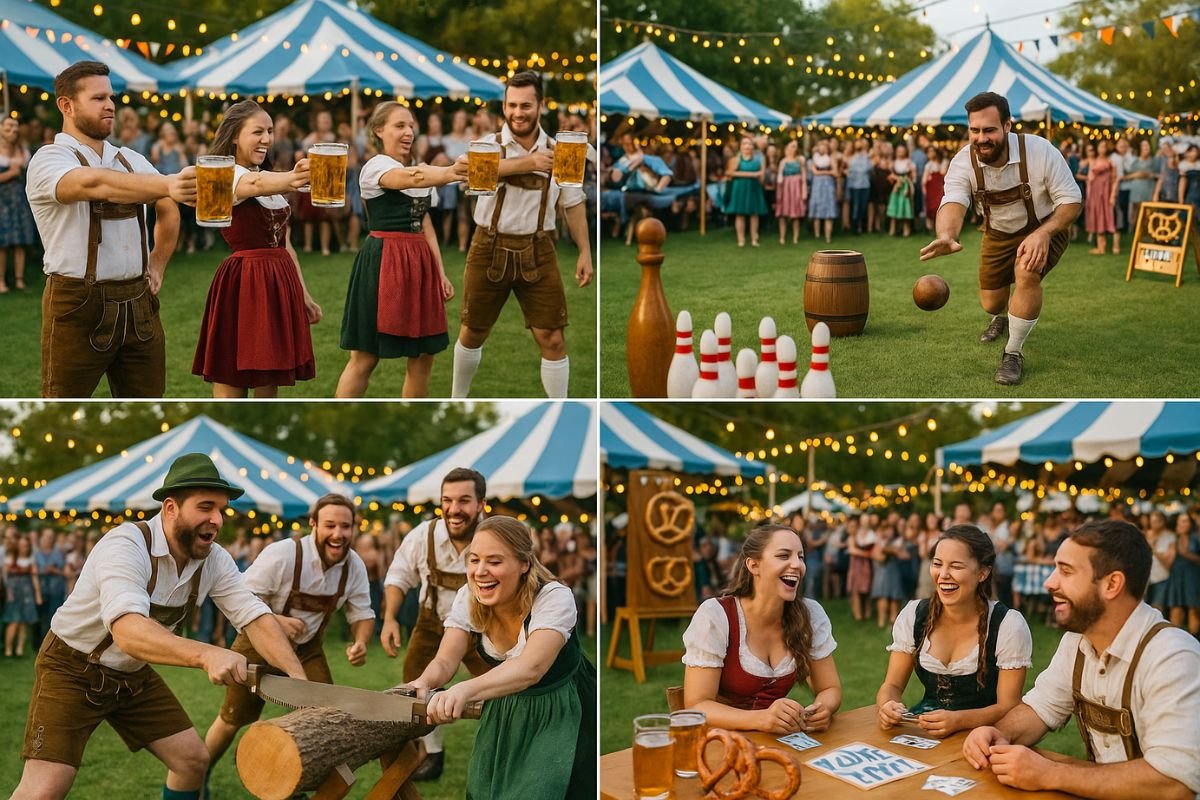
Top Oktoberfest Games for Adults: Traditional, Drinking & Party Guide
The most popular Oktoberfest games for adults include Masskrugstemmen (stein holding competition), Fingerhakeln (finger wrestling), log sawing contests, beer stein races, pretzel toss, keg bowling, and traditional Bavarian drinking games. These activities range from authentic German competitions testing strength and endurance to modern party games designed for backyard celebrations and festival tents. Traditional games like Masskrugstemmen challenge participants to hold a one-liter beer stein at arm’s length for as long as possible (world records exceed 20 minutes), while Fingerhakeln—an intense finger-wrestling match using leather straps—has Alpine origins dating back centuries. Modern adaptations include stein relay races, pretzel eating contests, and beer-themed versions of classic party games, all designed to capture Oktoberfest’s spirit of community, friendly competition, and Bavarian Gemütlichkeit (warm hospitality) whether you’re attending Munich’s original festival, Wisconsin’s La Crosse Oktoberfest, or hosting your own celebration at home.
Oktoberfest wouldn’t feel complete without the games, contests, and cultural activities that transform beer drinking into genuine celebration. From time-honored Bavarian challenges showcasing physical prowess to hilarious modern party games involving coordination and teamwork, these activities capture the communal spirit and playful competition that make Oktoberfest more than just a drinking event. Whether you’re attending a large-scale American festival or hosting your own themed party, understanding the traditional games, adapting them for modern settings, and organizing them effectively creates memorable experiences that honor Bavarian heritage while ensuring everyone has a fantastic time.
Quick Comparison: Oktoberfest Game Types
Understanding the different categories of Oktoberfest games helps you plan the perfect mix for any celebration or event.
| Game Category | Examples | Difficulty | Players | Duration | Equipment Needed | Best Setting |
| Traditional Bavarian | Masskrugstemmen, Fingerhakeln, Log Sawing | Medium-Hard | 2-20 | 5-15 min per round | Beer steins, leather straps, two-person saw, logs | Festival tents, outdoor spaces |
| Active Party Games | Stein races, Pretzel toss, Keg bowling | Easy-Medium | 4-30+ | 10-20 min per game | Steins, pretzels, mini kegs, pins | Outdoor areas, large indoor spaces |
| Drinking Games | Prost Challenge, Beer coaster flip | Easy | 4-20+ | 15-30 min continuous | Beer, coasters, timer | Beer tents, party rooms |
| Team Competitions | Barrel rolling, Stein relay | Medium | 6-40 (teams) | 10-25 min per round | Barrels, steins, obstacle course | Outdoor festival grounds |
| Mental/Trivia | Oktoberfest trivia, German culture quiz | Easy | 4-50+ | 20-45 min | Question cards, scoreboard, prizes | Any indoor/outdoor space |
Traditional Bavarian Oktoberfest Games: Authentic German Competitions
The most authentic Oktoberfest games originate from centuries-old Bavarian and Alpine traditions, designed to showcase physical strength, endurance, and community pride. These competitions remain the heart of serious Oktoberfest celebrations worldwide.
Masskrugstemmen: The Iconic Stein Holding Competition
Masskrugstemmen (literally “beer mug lifting”) stands as Oktoberfest’s most recognizable competition, testing raw endurance and mental fortitude in deceptively simple fashion.
How to Play Masskrugstemmen:
Competitors hold a full one-liter beer stein (weighing approximately 2.3 kilograms or 5 pounds when filled) straight out in front of their body with one arm fully extended. The arm must remain parallel to the ground throughout the competition—no bending at the elbow, no leaning backward for leverage, and no supporting the arm with the other hand. The challenge is maintaining this position as long as possible while trembling muscles threaten to give out.
Judges watch carefully for rule violations. The moment a competitor’s arm dips below parallel, bends at the elbow, or they use their other hand for support, they’re eliminated. What begins confidently usually deteriorates into visible shaking within the first minute. By two minutes, most casual participants have dropped out. Serious competitors might last three to five minutes, while festival champions occasionally exceed ten minutes. The current world record stands at an astounding 21 minutes and 9 seconds, set by German athlete Matthias Meindl in 2017.
Player Requirements:
- Participants: 5-50+ (unlimited, though heats of 10-20 work best)
- Age requirement: 21+ if using beer; 18+ with water-filled steins
- Physical demands: Upper body strength, shoulder endurance, mental toughness
- Duration: 1-3 minutes for most participants; up to 20+ minutes for champions
Equipment Specifications:
- One-liter beer steins (traditional glass or ceramic for authenticity; plastic acceptable for safety)
- Beer or water (water reduces waste and allows repeated attempts)
- Stopwatch or timer visible to judges
- Elevated platform or stage for visibility (optional but recommended for crowds)
Scoring and Competition Format:
Individual competition with last-person-standing wins. For large groups, organize preliminary heats where top 3-5 finishers from each heat advance to finals. Record times for all participants to recognize age-group winners, gender categories, or create leaderboards tracking improvements across multiple festival days.
Variations:
- Doubles Masskrugstemmen: Partners each hold one stein; team time equals when the first partner drops
- Alternating Arms: After elimination, competitors switch arms for second-chance round
- Progressive Weight: Start with empty stein, add liquid incrementally every 30 seconds
Fingerhakeln: Traditional Alpine Finger Wrestling
Originating in Alpine Bavaria and Austria, Fingerhakeln represents one of Oktoberfest’s most intense traditional competitions despite its minimal equipment requirements.
How to Play Fingerhakeln:
Two opponents sit across from each other at a solid table with a leather strap or rope looped between their middle fingers (some variations use index fingers). On the signal, both competitors pull simultaneously, attempting to drag their opponent across a center line marked on the table. The match ends when one competitor’s hand crosses the line or they release their grip from pain or fatigue.
Traditional Fingerhakeln uses specially crafted leather finger loops that distribute pressure more evenly than rope. The technique involves not just pulling strength but strategic timing—sudden jerks can catch opponents off-guard, while sustained pressure tests endurance. Experienced players develop callused fingers and specific grip techniques passed down through generations.
Player Requirements:
- Participants: 2 per match; tournaments accommodate 8-32 competitors
- Age requirement: Adults only; significant finger/hand strain involved
- Physical demands: Grip strength, pain tolerance, strategic timing
- Duration: 10 seconds to 3 minutes per match
Equipment Specifications:
- Sturdy table (must not slide during competition)
- Leather finger straps or thick rope (2-3 feet length)
- Center line marked clearly on table
- Padding underneath table edge (protects knuckles)
Tournament Organization:
Single-elimination brackets work best for Fingerhakeln tournaments. Seed competitors randomly or based on preliminary grip-strength tests. Championship matches become major spectator events—the tension and visible strain create dramatic entertainment despite the game’s simplicity.
Safety Considerations:
Participants should warm up hands and fingers beforehand. Establish clear rules about maximum match duration (typically 2-3 minutes) to prevent injury. Allow competitors to concede verbally without shame—Fingerhakeln can cause genuine pain, and pushing through injury risks sprains or worse.
Baumsägen: Traditional Log Sawing Competition
Log sawing competitions emerged from Bavaria’s forestry heritage, where skilled workers competed to demonstrate their lumberjack prowess during village celebrations.
How to Play Baumsägen:
Two-person teams work together using a traditional two-person crosscut saw to cut through a log section as quickly as possible. The log typically measures 12-18 inches in diameter and teams must saw completely through to separate a cookie (disk) from the main log. The challenge lies in coordinating rhythm—if one partner pulls while the other pushes, the saw binds and progress halts. Smooth, synchronized motion creates the fastest times.
Modern Oktoberfest log sawing often pairs couples, friends, or randomly matched partners, emphasizing teamwork over raw strength. Commentary and crowd encouragement make each round entertaining even for spectators unfamiliar with the tradition.
Player Requirements:
- Participants: 2 per team; tournaments accommodate 10-30 teams
- Age requirement: 18+ due to sharp saw blades
- Physical demands: Upper body strength, cardiovascular endurance, coordination
- Duration: 30 seconds to 3 minutes per team depending on log size and skill
Equipment Specifications:
- Traditional two-person crosscut saws (4-6 feet length)
- Fresh logs (softwood like pine cuts faster; hardwood like oak creates bigger challenge)
- Log holders or saw bucks (keep logs stable and at comfortable height)
- Safety goggles for participants
- Stopwatch for timing
- Measuring tape to ensure fair log sizes across all teams
Competition Format:
Time trials work best—teams compete one at a time against the clock rather than simultaneously (prevents collision hazards with swinging saws). Post times on a leaderboard and award medals for fastest men’s pair, women’s pair, and mixed pairs. Consider age-adjusted categories for fairness.
Pro Tips for Competitors:
Stand slightly offset from each other rather than directly across the log. Use your body weight to assist the pulling motion rather than relying on arm strength alone. Establish verbal rhythm counts (“One, two, pull!”) before starting. Let the saw’s teeth do the work—forcing pressure causes binding.
Steinwerfen: Stone Throwing Competition
Less common than other games but traditionally Bavarian, Steinwerfen tests distance throwing with smooth river stones.
How to Play:
Participants throw a stone (typically 2-5 pounds) as far as possible from a designated throwing line. Three throws per competitor, with the longest throw determining placement. Traditional versions used stones found in local rivers; modern versions may use standardized weighted balls for fairness.
Equipment: Smooth stones or weighted balls, measuring tape, marked throwing area, safety cones
Best For: Outdoor festivals with significant space (requires 50+ feet of clear area)
Hammerschlagen: Nail Driving Competition
German strongman tradition involving driving nails into a tree stump with minimal hammer swings.
How to Play:
Participants receive one nail partially started in a wood stump or log. Using a small hammer, they must drive the nail completely flush in as few strikes as possible. Speed versions involve timing rather than counting swings.
Equipment: Tree stump or thick wood block, large nails (16-20 penny size), small hammers
Variations: Blindfolded Hammerschlagen, non-dominant hand only, or timed rather than swing-counted
Modern Party Games for Oktoberfest: Fun for Everyone
While traditional Bavarian games honor heritage, modern Oktoberfest party games emphasize accessibility, laughter, and social interaction—perfect for backyard celebrations or festival entertainment zones.
Beer Stein Race: Balance and Speed Challenge
The Beer Stein Race combines coordination, speed, and nerve as competitors race while carrying full steins without spilling.
How to Play:
Mark a race course (typically 20-50 feet). Competitors must walk, speed-walk, or jog while carrying a full beer stein, maintaining liquid levels above a marked fill line. Spills result in time penalties (typically 5 seconds per ounce spilled) or disqualification for major spills. Fastest adjusted time wins.
Player Requirements:
- Participants: 4-30+ (run heats if necessary)
- Duration: 1-3 minutes per heat
- Difficulty: Easy-Medium (coordination required)
Equipment:
- Beer steins (6-10 per heat)
- Beer or colored water (beer creates authentic atmosphere but water reduces waste)
- Measured fill lines marked on steins (typically 90% full)
- Race course markers (cones, chalk lines, or rope)
- Towels for cleanup
- Stopwatch
Competition Variations:
- Relay Format: Teams of 3-5, each member completes one lap
- Obstacle Course: Add weaving cones, step-ups, or spinning requirements
- Blindfolded Partner: One partner guides blindfolded runner carrying stein
- Tray Carry: Hold multiple steins on serving tray for added difficulty
Pretzel Toss: Carnival-Style Accuracy Game
Pretzel Toss brings carnival game simplicity to Oktoberfest themes with minimal equipment requirements.
How to Play:
Set up target pegs, hooks, or stein handles at varying distances (typically 5, 10, and 15 feet). Players receive 5-10 soft pretzels (real or foam rings) and attempt to land them on targets. Assign points by distance—closer targets worth fewer points, distant targets worth more. Highest total score after all throws wins.
Player Requirements:
- Participants: Unlimited (take turns)
- Duration: 2-5 minutes per player
- Difficulty: Easy (accessible to all skill levels)
Equipment:
- Soft pretzels, foam pretzel rings, or rope rings
- Target pegs, coat hooks, or empty stein handles arranged at distances
- Scoreboard
- Marked throwing line
Setup Variations:
- Moving Targets: Hang swinging targets for added challenge
- Team Competition: Teams accumulate combined scores
- Blackout: Assign point values to all targets; first to score on all targets wins
- Speed Round: 30-second clock to throw as many successful tosses as possible
Keg Bowling: Oktoberfest Spin on Classic Game
Keg Bowling replaces traditional bowling balls with small barrels or rubber kegs for rustic charm.
How to Play:
Set up 6-10 pins (plastic bottles, wooden blocks, or traffic cones) in bowling formation. Players roll small kegs, barrels, or large balls to knock down pins. Standard bowling scoring applies, or simplify to count total pins per round. Three rounds per player typical.
Player Requirements:
- Participants: 4-20 (rotate turns)
- Duration: 5-10 minutes per player (3 rounds)
- Difficulty: Easy
Equipment:
- Mini beer kegs, small barrels, or large rubber balls (6-12 inches diameter)
- 6-10 pins (plastic bottles filled with sand/water for stability work well)
- Bowling lane (marked with tape or chalk; 15-30 feet length)
- Scoreboard
Pro Tips:
Weight distribution matters—aim for consistent barrel/ball weight across all equipment. Set pins on grass or textured surface rather than smooth concrete for added challenge and pin stability.
Pretzel Eating Contest: Speed and Stamina Test
Simple, entertaining, and perfectly thematic—the Pretzel Eating Contest challenges competitors’ capacity for salty carbohydrates.
How to Play:
Competitors race to eat a set number of soft pretzels (typically 3-5) as quickly as possible. No water allowed until finishing all pretzels. First person to consume all pretzels and display empty mouth wins. Judges watch carefully for cheating (hiding pretzels) and confirm complete swallowing.
Player Requirements:
- Participants: 5-15 per heat (works best with fewer for judge visibility)
- Duration: 2-8 minutes typical (varies dramatically by competitor)
- Difficulty: Medium (surprisingly challenging without water)
Equipment:
- Soft pretzels (3-5 per competitor; standard festival pretzels work perfectly)
- Plates or napkins
- Water available immediately after completion
- Timer
- Judges (2-3 to monitor all competitors)
Safety Considerations:
Screen for choking hazards—exclude anyone with swallowing difficulties. Have water immediately available and know Heimlich maneuver. Consider limiting pretzel quantity for safety (3 pretzels sufficient for most competitions).
Stein Relay Race: Team Coordination Challenge
The Stein Relay Race emphasizes teamwork, coordination, and controlled passing under pressure.
How to Play:
Teams line up in rows (typically 4-6 people per team). First person carries full stein through obstacle course (zigzag cones, step over ropes, spin in circle, etc.) and hands it to next teammate. Continue until all team members complete the course. Team with fastest time and most beer remaining wins. Spills add time penalties.
Player Requirements:
- Participants: 8-30 (teams of 4-6)
- Duration: 3-8 minutes per team
- Difficulty: Medium
Equipment:
- One stein per team (filled 90%)
- Obstacle course markers (cones, ropes, hula hoops, etc.)
- Stopwatch
- Measuring cup (to quantify remaining beer for penalty calculation)
Scoring Formula:
Base time + (5 seconds × ounces spilled) = final time. Lowest final time wins.
Hammerschlagen Speed Rounds
Adapted from traditional version for modern party settings with continuous rapid-play format.
How to Play:
Large stump contains dozens of partially started nails. Players take turns striking any nail once per turn, rotating rapidly around the stump. First person to drive their claimed nail flush wins that round. Multiple rounds allow everyone chances to win.
Equipment: Large tree stump or industrial wood block, 20-50 nails, lightweight hammers
Best For: Outdoor parties, beer gardens, festival tent areas with room for gathered crowds
German Drinking Games for Oktoberfest Celebrations
Drinking games at Oktoberfest emphasize social connection and light-hearted competition rather than excessive consumption. These adult-friendly activities keep crowds engaged between other events.
Prost! Challenge: High-Alert Party Game
The Prost! Challenge keeps everyone engaged throughout the entire celebration with unexpected participation requirements.
How to Play:
Throughout the party, anyone can suddenly shout “Prost!” At that moment, everyone must immediately raise their drink and take a sip while making eye contact with someone nearby. Anyone who misses the cue—doesn’t have a drink ready, doesn’t raise their glass, or fails to make eye contact—owes a penalty drink or must perform a small forfeit (sing a line, do a silly dance, etc.).
Game Variations:
- Prost Captain: Rotate who has authority to call Prost throughout the night
- Language Version: Must say “Prost” in different language each time (German, English, Spanish, etc.)
- Pyramid: Person who called Prost chooses someone to toast; that person chooses another; creates chain reaction
Best For: Ongoing background game during meal times or between structured activities
Bierdeckel Flip: Beer Coaster Coordination Test
Beer coaster flipping tests hand-eye coordination and reflexes with simple props found at every festival table.
How to Play:
Place a beer coaster (Bierdeckel) on your elbow with arm bent at 90 degrees. Quickly straighten your arm while simultaneously snatching the coaster from the air before it falls. Successfully catch? No consequence. Drop it? Take a drink. Advanced players stack multiple coasters for difficulty multipliers.
Player Requirements:
- Participants: 4-20 (take turns)
- Duration: Continuous (quick turns)
- Difficulty: Easy-Medium
Equipment:
- Beer coasters (10-20)
- Drinks for all players
- Small table area
Progressive Challenges:
- Start with one coaster; add coasters each successful round
- Compete for most coasters caught simultaneously
- Speed round—30 seconds to catch as many coasters as possible
Das Boot Challenge: The Famous Beer Boot
Made internationally famous by the film “Beerfest,” Das Boot involves drinking from the iconic glass boot with strategic technique to avoid beer explosions.
How to Play:
Competitors drink from the glass boot, which must be held with the toe pointing away from the drinker throughout. As beer level drops, air bubble forms in the toe. When the bubble releases (typically around halfway empty), beer rushes forward suddenly—creating potential for spills or choking. The trick involves tilting the boot gradually to control bubble release. Fastest clean finish wins.
Equipment: Glass or plastic beer boots (Das Boot), beer, stopwatch
Safety: Not recommended for beginners; best for experienced drinkers familiar with the technique
German Card Drinking Game: Kings Cup Oktoberfest Edition
Adapt the classic Kings Cup with Oktoberfest-themed rules for each card drawn.
Themed Rules:
- Ace: Waterfall (everyone drinks)
- King: Pour beer in center “Das Boot” cup; fourth King drinks it all
- Queen: Question Master (ask questions; responder drinks)
- Jack: “Prost Rule” creator (make a rule that lasts the game)
- Numbers: Various challenges (sing German song, name Oktoberfest foods, etc.)
Equipment: Standard playing cards, beer, center cup
Quarters (German Style): Münzwurf
Bounce quarters into shot glasses or small cups filled with beer. Successful bounces let you assign drinks to others; misses mean you drink.
Equipment: Quarters or Euro coins, shot glasses, beer, hard table surface
Oktoberfest Trivia: Test Your Festival Knowledge
Trivia games add educational entertainment to Oktoberfest celebrations, perfect for resting between physical activities.
Essential Oktoberfest Trivia Questions by Category
History & Origins
- In what year did the first Oktoberfest take place? (Answer: 1810)
- What royal event started the Oktoberfest tradition? (Answer: Crown Prince Ludwig’s wedding to Princess Therese)
- How many days does Munich’s official Oktoberfest typically last? (Answer: 16-18 days)
- Which Munich mayor traditionally taps the first keg? (Answer: The current Munich mayor)
- What Bavarian phrase is traditionally shouted at keg tapping? (Answer: “O’zapft is!”—”It’s tapped!”)
Beer & Breweries
- How many Munich breweries are allowed to serve at official Oktoberfest? (Answer: Six—Augustiner, Hacker-Pschorr, Hofbräu, Löwenbräu, Paulaner, Spaten)
- What is a Masskrug? (Answer: One-liter beer stein)
- What type of beer is traditionally served at Oktoberfest? (Answer: Märzen or Festbier)
- What does “Prost” mean? (Answer: Cheers/To your health)
Food & Culture
- What is a traditional Oktoberfest chicken called? (Answer: Hendl)
- What’s the Bavarian word for the Oktoberfest grounds? (Answer: Wiesn, short for Theresienwiese)
- What traditional Bavarian dance is performed at Oktoberfest? (Answer: Schuhplattler or Polka)
- What is traditional Bavarian clothing called? (Answer: Trachten—specifically Dirndl for women, Lederhosen for men)
Running Trivia Competition Successfully
Pub Quiz Format:
Divide guests into teams of 4-6 people. Ask 20-30 questions across multiple rounds (History, Beer, Food, Music, Modern Oktoberfest). Award points per correct answer. Highest total wins. Include a few “phone-a-friend” or “poll the audience” lifelines for difficult questions.
Speed Trivia:
Ask questions rapid-fire with immediate answers required. First person/team to shout correct answer earns point. Fast-paced and energetic—works well for large crowds.
Digital Trivia:
Use apps like Kahoot or Quizizz for smartphone-based trivia with real-time scoreboards and timed questions. Particularly effective for younger crowds familiar with digital platforms.
Prize Suggestions:
Festival tokens, beer steins, German snack baskets, gift cards to German restaurants, traditional Bavarian accessories like hats or socks.
Planning Guide: Organizing Oktoberfest Games Successfully
Executing Oktoberfest games successfully requires preparation, proper equipment, smart timing, and attention to participant experience.
Complete Equipment Checklist and Cost Estimates
| Equipment Item | Quantity Needed | Estimated Cost | Where to Purchase | Notes |
| Beer Steins (1 liter) | 12-24 | $80-$200 | Party supply stores, Amazon | Plastic for safety; glass for authenticity |
| Pretzel Rings (soft or foam) | 50-100 | $20-$50 | Craft stores, online | Foam lasts longer; real pretzels more authentic |
| Mini Barrels/Kegs | 3-6 | $40-$100 | Party supply, brewery suppliers | Rubber or small wooden barrels work |
| Two-Person Saw | 1-2 | $40-$80 | Hardware stores, lumber suppliers | Borrow from woodworking clubs |
| Logs for Sawing | 3-6 logs | $0-$30 | Free from tree services; hardware stores | 12-18 inch diameter, 6-8 inch cookies |
| Leather Finger Straps | 2-4 | $10-$30 | Leather craft stores, online | Can make DIY with rope |
| Bowling Pins | 10-20 | $20-$60 | Dollar stores, sporting goods | Plastic bottles filled with sand work |
| Beer Coasters | 50-100 | $10-$25 | Party supply, brewing suppliers | German-themed designs preferred |
| Stopwatch/Timers | 2-4 | $10-$40 | Sporting goods, online | Smartphone apps work as backup |
| Scoreboards | 2-4 | $20-$80 | Office supply, online | Whiteboards, poster boards, or digital displays |
| Obstacle Course Items | 10-15 | $30-$80 | Sporting goods, DIY | Cones, hula hoops, ropes, pool noodles |
| Safety Equipment | As needed | $30-$60 | Hardware stores | First aid kit, gloves, safety goggles |
| Decorations | Various | $50-$150 | Party supply stores | Bavarian flags, banners, tablecloths |
| Prizes | 10-20 items | $50-$200 | Various | Beer tokens, novelty items, gift cards |
| Total Estimated Cost | — | $410-$1,165 | — | Scales based on event size |
Setting Up Game Stations Effectively
Zone Organization:
Create distinct areas for different game types to manage flow and prevent overcrowding. Designate:
- Strength Zone: Masskrugstemmen, Hammerschlagen (needs solid surfaces, timers, scoreboards)
- Active Zone: Stein races, barrel rolling, keg bowling (requires space for movement)
- Skill Zone: Pretzel toss, beer coaster flip (compact, can fit near seating areas)
- Team Zone: Log sawing, relay races (needs supervision, safety equipment)
- Trivia Corner: Quiet area with seating, screen or whiteboard
Visual Staging:
Use Bavarian-themed decorations to define game areas—blue-and-white checkered tablecloths, wooden barrels as props, German flag colors (black, red, gold) in banners, rustic wooden signage with game names written in both English and German for authenticity.
Signage Requirements:
Each game station needs clear signage explaining:
- Game name (English and German if possible)
- Number of players required
- Basic rules (2-4 bullet points maximum)
- Safety warnings if applicable
- Current leaderboard or standings
Timing and Schedule Planning
| Time Block | Game Activities | Duration | Purpose |
| 12:00-1:00 PM | Registration, warm-up games (pretzel toss, coaster flip) | 60 min | Ease guests into festivities |
| 1:00-2:00 PM | Traditional games—Masskrugstemmen qualifying heats | 60 min | Afternoon signature event |
| 2:00-3:00 PM | Team competitions—log sawing, barrel rolling | 60 min | Encourage group participation |
| 3:00-4:00 PM | Free play, trivia round 1 | 60 min | Rest period with mental games |
| 4:00-5:00 PM | Stein relay races, keg bowling | 60 min | Build energy for evening |
| 5:00-6:00 PM | Masskrugstemmen finals, Fingerhakeln tournament | 60 min | Premier evening competition |
| 6:00-7:00 PM | Dinner, polka dancing | 60 min | Social bonding, recovery time |
| 7:00-8:00 PM | Drinking games, party competitions | 60 min | Evening entertainment |
| 8:00-9:00 PM | Championship finals, trivia round 2, awards | 60 min | Grand finale celebration |
Flexibility Tips:
Build 10-15 minute buffers between scheduled events. Weather delays, equipment issues, or unexpectedly popular games often extend timelines. Announce schedule changes clearly and update signage promptly.
Prize and Reward Ideas by Budget
| Budget Tier | Prize Ideas | Approximate Cost per Prize | Best For |
| Budget ($1-$10) | Beer tokens, German candy bars, novelty buttons, small flags | $1-$5 | Participation prizes, all competitors |
| Mid-Range ($10-$25) | Beer steins, Bavarian hats, T-shirts, gift cards (local German restaurant) | $10-$20 | Category winners, heat champions |
| Premium ($25-$50) | Traditional Lederhosen suspenders, Dirndl accessories, premium beer glass sets | $25-$40 | Overall champions, tournament winners |
| Grand Prize ($50+) | Authentic Lederhosen or Dirndl gift certificate, München trip raffle entry, custom championship belt | $50-$200 | Grand champion, most valuable player |
Safety Guidelines and Responsible Play
Physical Activity Safety:
Require all participants to sign simple waiver forms acknowledging physical game risks. Screen for pre-existing injuries that might be aggravated by strength competitions. Have first aid kit prominently displayed and ensure someone present knows basic first aid. For sawing and Hammerschlagen, require safety goggles and gloves.
Alcohol Management:
Provide abundant water stations throughout venue. Offer food alongside all drinking games. Establish clear maximum alcohol limits—games should enhance fun, not encourage dangerous consumption. Have designated sober volunteers monitoring participants for signs of over-intoxication. Arrange transportation options for guests who shouldn’t drive.
Crowd Management:
For large events (100+ attendees), use number systems or time slots to prevent dangerous crowding at popular game stations. Create clear pathways between zones marked with tape or rope. Position security/volunteers at high-traffic intersections.
Weather Considerations:
For outdoor events, have contingency plans for rain (move to covered areas, switch to indoor games) and heat (provide shade, extra water, shorten game durations). Cancel or modify games if wind exceeds 20 mph (affects stein holding, pretzel toss accuracy).
Adapting Games for Different Settings
Home Parties (10-20 guests):
Focus on 4-6 games maximum. Choose space-efficient options: Masskrugstemmen, beer coaster flip, pretzel toss, trivia, one team relay. Use living room, backyard, or basement. Emphasize participation over competition—everyone should win something. Total equipment investment: $100-$200.
Large Festivals (200+ guests):
Run multiple game stations simultaneously with dedicated volunteers managing each. Use tournament bracket systems for popular games like Masskrugstemmen (heats throughout day, finals in evening). Hire professional announcer to call competitions and build crowd energy. Total equipment investment: $500-$1,000+.
Corporate Events:
Emphasize team-building games: log sawing pairs, stein relays, barrel rolling races. Include trivia with company-specific questions mixed in. Avoid excessive drinking games—focus on physical competitions and skill challenges. Provide branded prizes (company logo steins, shirts, etc.).
Bar/Restaurant Events:
Choose space-appropriate games for indoor venues: Masskrugstemmen (main attraction), beer coaster flip, Hammerschlagen (if outdoor patio available), trivia nights. Many bars run weekly Oktoberfest game nights during September-October, building regular customer engagement.
Frequently Asked Questions About Oktoberfest Games
What are the most popular Oktoberfest games for adults?
The most popular Oktoberfest games for adults are Masskrugstemmen (stein holding competition), stein relay races, pretzel toss, keg bowling, log sawing competitions, and Bavarian drinking games like the Prost Challenge. Masskrugstemmen stands as the signature Oktoberfest competition, testing how long participants can hold a one-liter beer stein at arm’s length—typically 1-3 minutes for casual players, though champions may exceed 10-20 minutes. These games blend traditional Bavarian heritage with modern party entertainment, emphasizing community participation, friendly competition, and the festive Gemütlichkeit spirit central to Oktoberfest celebrations. For authenticity, major festivals like Munich Oktoberfest, La Crosse Oktoberfest in Wisconsin, and New Glarus Oktoberfest feature traditional competitions alongside contemporary party games.
What is Masskrugstemmen and how do you win?
Masskrugstemmen is the traditional Bavarian stein holding competition where participants hold a one-liter beer stein (weighing approximately 5 pounds when filled) straight out in front of their body with arm fully extended and parallel to the ground. To win, you must maintain this position longer than all other competitors without bending your elbow, lowering your arm below parallel, or using your other hand for support. Most casual participants last 1-3 minutes before muscle fatigue forces them out, while experienced competitors may last 5-10 minutes. The current world record stands at 21 minutes and 9 seconds, set by German athlete Matthias Meindl in 2017. Winning requires upper body strength, shoulder endurance, and mental toughness to push through trembling muscles and burning pain.
How long can people hold a beer stein in Masskrugstemmen?
Most casual participants in Masskrugstemmen can hold a beer stein for 1-3 minutes before their arm gives out from fatigue. Experienced competitors or those with significant upper body strength typically last 3-5 minutes, while serious festival champions may reach 8-12 minutes. Elite-level record holders have exceeded 20 minutes—the current world record stands at 21 minutes and 9 seconds. The challenge intensifies because the arm must remain perfectly parallel to the ground with no bending at the elbow or support from the other hand. What feels manageable for the first 30 seconds becomes progressively more painful as shoulders burn and arms shake uncontrollably. Training specifically for Masskrugstemmen through shoulder exercises and gradual endurance building can significantly improve holding times.
What equipment do I need for Oktoberfest games at home?
For a complete home Oktoberfest game party, you’ll need: 12-24 beer steins (plastic for safety or glass for authenticity, approximately $80-$200), 50-100 soft or foam pretzel rings ($20-$50), 3-6 mini barrels or rubber kegs ($40-$100), bowling pins or plastic bottles ($20-$60), beer coasters ($10-$25), stopwatches or timers ($10-$40), scoreboards ($20-$80), and obstacle course items like cones and ropes ($30-$80). Optional but highly recommended equipment includes a two-person saw with logs for authentic log sawing ($40-$80 plus logs), leather finger straps for Fingerhakeln ($10-$30), and Bavarian decorations ($50-$150). Total equipment investment ranges from $300-$800 depending on game selection and quality choices. Most items are reusable across multiple years, making the investment worthwhile for annual celebrations.
Are Oktoberfest games safe for all adults?
Most Oktoberfest games are safe for adults with reasonable fitness levels, though certain games require specific considerations. Physical competitions like Masskrugstemmen, log sawing, and barrel rolling demand upper body strength and cardiovascular endurance—participants with shoulder injuries, back problems, or heart conditions should consult doctors before competing. Fingerhakeln can cause finger strain or sprains if played too aggressively, so establish maximum match durations (2-3 minutes) and allow participants to concede without shame. Drinking games require responsible alcohol management—provide water stations, offer food, establish consumption limits, and monitor participants for over-intoxication. Games involving sharp tools (saws for log cutting, hammers for Hammerschlagen) require safety equipment like goggles and gloves plus careful supervision. Overall, Oktoberfest games emphasize fun over extreme challenge, making them accessible to most adults when organizers prioritize safety and common sense.
What is Fingerhakeln and how do you play?
Fingerhakeln is a traditional Alpine finger wrestling competition where two opponents sit across from each other at a table with a leather strap or rope looped around their middle fingers (sometimes index fingers). On the signal, both players pull simultaneously, attempting to drag their opponent across a center line marked on the table or force them to release their grip from pain or fatigue. The match ends when one competitor’s hand crosses the line or they concede defeat. Traditional Fingerhakeln uses specially crafted leather finger loops that distribute pressure more evenly than rope, though rope works for casual games. Technique involves not just raw pulling strength but strategic timing—sudden jerks can catch opponents off-guard while sustained pressure tests endurance. Matches typically last 10 seconds to 3 minutes, and organized tournaments use single-elimination brackets to determine champions.
Can I organize Oktoberfest games for children too?
Yes, many Oktoberfest games can be adapted safely for children by removing alcohol, adjusting physical demands, and emphasizing fun over competition. Child-friendly versions include: pretzel toss with foam rings (all ages), keg bowling using soft balls or mini kegs (ages 6+), modified stein races carrying plastic cups with colored water (ages 5+), simple relay races without obstacles (ages 4+), and Oktoberfest trivia with age-appropriate questions (ages 8+). Skip intense physical competitions like Masskrugstemmen, Fingerhakeln, and log sawing for children—these require adult strength and present injury risks. Replace drinking games with root beer or apple cider versions. Include activities like German folk dancing lessons, craft stations for decorating foam Lederhosen or Dirndl coloring pages, and storytelling about Oktoberfest history. Family-friendly Oktoberfest events balance adult competitions with inclusive activities ensuring everyone participates safely.
How do you organize an Oktoberfest game tournament?
Organize an Oktoberfest game tournament by first selecting 4-6 core games based on your venue size and expected attendance. Create distinct game zones with clear signage explaining rules, player requirements, and current standings. Develop a realistic schedule allocating 45-60 minutes per major competition including setup, multiple heats, and finals. Use single-elimination or round-robin brackets for head-to-head games like Fingerhakeln and log sawing. For endurance games like Masskrugstemmen, run preliminary heats where top 3-5 finishers from each heat advance to evening finals. Assign volunteers to manage each station, track scores, ensure safety, and maintain equipment. Prepare prizes for multiple categories: overall champions, age-group winners, team competitions, and participation awards. Print professional-looking brackets or leaderboards updated throughout the day. Consider hiring an announcer to call competitions and build crowd energy at major events.
What prizes should I give for Oktoberfest game winners?
Appropriate Oktoberfest game prizes range from small participation rewards to premium grand prizes based on budget and competition level. Budget-friendly options ($1-$10) include beer tokens, German candy bars, novelty buttons, small flags, and Bavarian-themed stickers—perfect for all participants. Mid-range prizes ($10-$25) suitable for category winners include beer steins, traditional Bavarian hats, Oktoberfest t-shirts, German snack baskets, or gift cards to local German restaurants. Premium prizes ($25-$50) for tournament champions might include traditional Lederhosen suspenders, Dirndl accessories, artisan beer glass sets, or German cookbook collections. Grand prizes ($50-$200+) for overall event champions could be gift certificates toward authentic Lederhosen or Dirndl dresses, Munich trip raffle entries, or custom championship belts/medals. The key is matching prize value to competition significance while ensuring everyone receives recognition for participation.
How much space do I need for Oktoberfest games?
Space requirements vary dramatically by game type and participant numbers. For home parties (10-20 guests), a standard backyard (20×30 feet minimum) accommodates most games: Masskrugstemmen requires only 6×6 feet per participant, pretzel toss needs 5×15 feet, and stein relay races need 10×40 feet. Keg bowling requires 5×30 feet clear space. Indoor games like beer coaster flip and trivia need minimal space—just table seating for participants. For large festival setups (100+ guests), allocate significantly more area: 20×40 feet for log sawing stations with spectator zones, 30×50 feet for barrel rolling races, and 40×60 feet for multiple simultaneous stein relay courses. Always add 30-50% buffer space around active game zones for safety, spectator viewing, and traffic flow. Outdoor venues work best for full game variety, while indoor venues limit options to strength competitions and tabletop games.
What are traditional Bavarian Oktoberfest competitions?
Traditional Bavarian Oktoberfest competitions originate from centuries-old Alpine and farming traditions testing physical strength, endurance, and community pride. The most authentic games include Masskrugstemmen (stein holding endurance test), Fingerhakeln (finger wrestling with leather straps), Baumsägen (two-person log sawing), Steinwerfen (stone throwing for distance), Hammerschlagen (nail driving into tree stumps), and Schuhplattler (traditional competitive folk dancing). These competitions were originally community events where villagers showcased skills relevant to rural Bavarian life—lumberjacks demonstrated sawing prowess, farmers showed strength through stone throwing, and brewery workers competed in stein-holding endurance. Modern Oktoberfest celebrations at Munich’s Theresienwiese grounds maintain these traditions while adapting rules for safety and accessibility. Understanding the cultural heritage behind these games adds meaningful depth to contemporary celebrations.
How do you score Oktoberfest game competitions fairly?
Fair scoring in Oktoberfest competitions depends on game type and format. For endurance games like Masskrugstemmen, use precise timing with judges watching for rule violations (arm dropping below parallel, elbow bending, using other hand for support)—longest clean time wins. For racing games like stein relays or barrel rolling, calculate final scores using base time plus penalties for spills (typically 5 seconds per ounce spilled for liquid events). Accuracy games like pretzel toss assign point values by distance (closer targets worth fewer points, distant targets more)—highest total after set number of throws wins. Team competitions benefit from cumulative scoring where each team member’s performance contributes to total team score. Always use multiple judges (2-3 minimum) for subjective games like Fingerhakeln to prevent disputes. Post running leaderboards prominently and update them immediately after each heat to maintain excitement and transparency. Consider age-adjusted scoring categories or gender divisions to ensure fair competition across diverse participant pools.
Making Your Oktoberfest Games Unforgettable
Oktoberfest games represent far more than simple entertainment—they embody the communal spirit, playful competition, and cultural heritage that transform beer drinking into genuine celebration. Whether you’re organizing traditional Bavarian competitions testing strength and endurance, modern party games emphasizing laughter and teamwork, or drinking games fostering social connection, these activities create the memorable experiences that define successful Oktoberfest events.
The most successful Oktoberfest game celebrations balance authenticity with accessibility. Honor traditional games like Masskrugstemmen and Fingerhakeln that connect modern celebrations to centuries of Bavarian heritage, while incorporating contemporary party games ensuring everyone participates regardless of physical ability or cultural familiarity. Emphasize safety through proper equipment, clear rules, responsible alcohol management, and attentive supervision. Most importantly, remember that Oktoberfest games exist to bring people together—winning matters less than the shared laughter, friendly competition, and community bonds formed through playful participation.
As you plan your own Oktoberfest celebration, start with 4-6 core games matching your venue size and guest demographics. Invest in quality equipment that lasts multiple years rather than disposable props. Create clear schedules allowing enough time for each competition plus buffers for delays. Prepare prizes recognizing various achievement levels from participation to championship. With proper planning and genuine enthusiasm for Bavarian tradition, your Oktoberfest games will create lasting memories capturing the true spirit of this beloved celebration.
Ready to host an unforgettable Oktoberfest celebration? Complete your planning with authentic German Oktoberfest Lederhosen and traditional Bavarian Dirndl dresses that honor the heritage behind these time-tested games and competitions.

Bavarian heritage and fashion specialist · Lead content
contributor, German Attire
About Anna
Anna Bauer grew up in Munich, where traditional dress is not a costume but everyday formal wear. Trachten appears at weddings, at church, at village festivals and in public life, and that ordinary familiarity shapes how she writes about it. She studied fashion and textile design at the Berlin University of the Arts, specialising in European folkwear. Over more than a decade since, she has worked with Trachten designers and styled outfits for Oktoberfest events across Germany.
What she writes about
- The history and regional variation of Bavarian and Alpine dress
- How Dirndl and Lederhosen are constructed, and what separates
authentic garments from costume versions - Fabric patterns and embroidery motifs, and what they mean
- Styling traditional dress for festivals, weddings and formal
occasions - Fit, sizing and care
Her approach
Anna’s writing starts from a simple position: traditional dress deserves to be explained accurately. Much of the English-language information about Lederhosen and Dirndl repeats claims that no Bavarian would recognise. Her work aims to correct that, and to give readers outside Germany enough context to wear Trachten with confidence rather than guesswork.