Get 5% Off – Use promo code German Attire


History of the Dirndl? From Folk Dress to Oktoberfest Icon
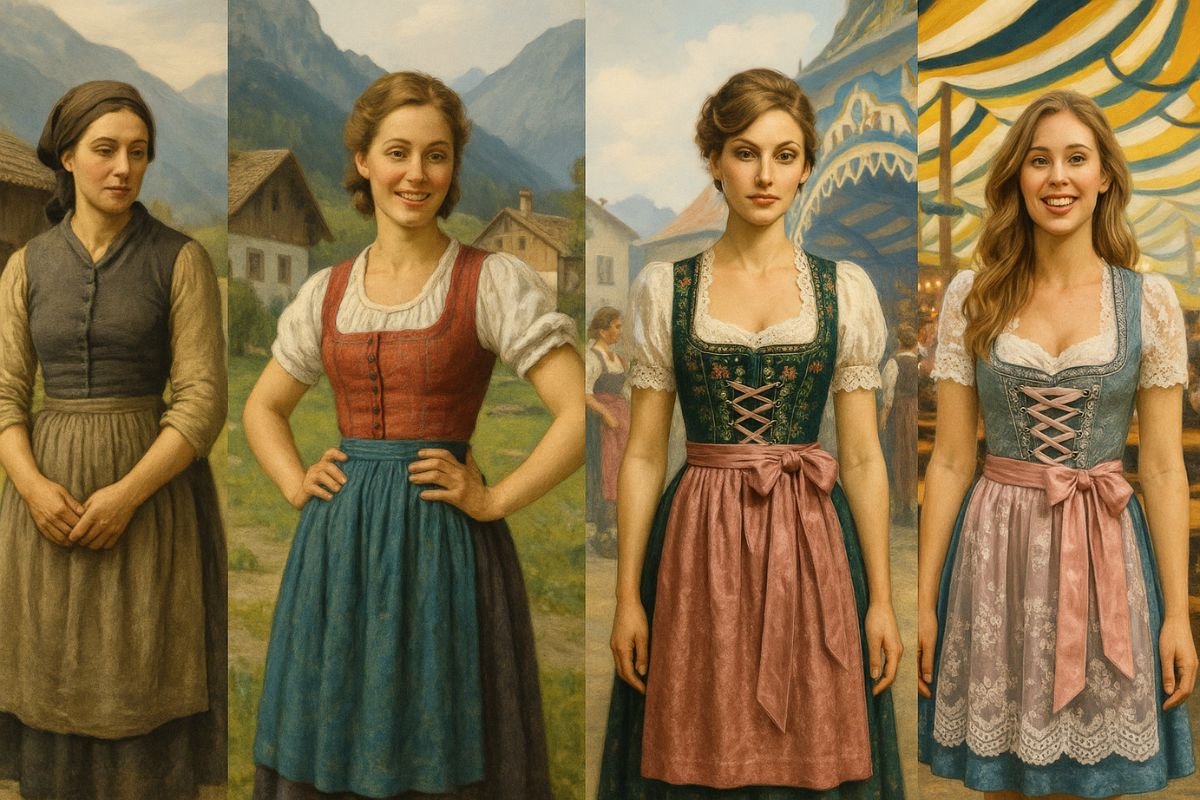
History of the Dirndl: From Alpine Workwear to Global Fashion Icon
In 1870, a Bavarian dairy maid named Anna pulled on her work dress—heavy wool skirt, simple cotton blouse, sturdy linen apron—and headed to the cowshed for another dawn of milking. The garment she wore had no special name; it was simply “what servants wore.” One hundred fifty years later, a model glides down a Munich Fashion Week runway wearing Anna’s descendant garment—a €800 silk dirndl with hand-embroidered edelweiss, photographed by international press and featured in Vogue. Between these two moments lies a remarkable transformation: How did anonymous Alpine workwear evolve into haute couture? How did servants’ uniforms become symbols of regional pride worn by royalty, appropriated by fascists, nearly forgotten, then spectacularly resurrected as global fashion?
The dirndl’s journey spans three centuries, crossing boundaries between social classes, surviving political weaponization, weathering near-extinction, and ultimately emerging as one of Europe’s most recognizable traditional garments. This history reveals more than fashion evolution—it illuminates changing attitudes toward rural life, women’s roles, regional identity, and cultural preservation. Understanding where dirndls came from, who shaped their development, why they nearly disappeared, and how they returned helps explain why millions wear them today at festivals, weddings, and celebrations worldwide.
Origins in the Alpine Peasant Class (1700s-1850s)
The dirndl emerged not from royal courts or fashion houses but from the practical clothing needs of Alpine working women living in mountainous regions spanning present-day Bavaria, Austria, and South Tyrol.
Pre-Dirndl Peasant Dress
Before the garment acquired its distinctive form and name, Alpine peasant women wore practical, regionally varied work clothing designed for harsh mountain conditions and agricultural labor. These outfits typically consisted of: heavy wool or linen skirts reaching ankle length for warmth and protection from rough terrain, simple cotton or linen shifts serving as blouses, practical aprons protecting clothing during farmwork and household tasks, and thick wool shawls or jackets for Alpine winters.
Regional variations existed even then—women in the Salzkammergut (Austrian lake district) favored different fabrics and cuts than those in the Bavarian Alps or South Tyrolean valleys. However, all shared common functional requirements: durability for hard labor, warmth for mountain weather, and practicality for daily wear costing minimal money in communities where fabric represented significant expense.
The Name “Dirndl” Emerges
The word “Dirndl” derives from “Dirn,” a southern German and Austrian dialectical term meaning “girl” or “young woman.” The diminutive form “Dirndl” literally translates as “little girl” or “young maiden,” initially referring not to the dress itself but to the servant girls who wore it. In the early-to-mid 1800s, wealthy Bavarian and Austrian households employed young women from Alpine villages as domestic servants—maids, kitchen workers, nannies. These servants needed uniforms distinguishing them from family members while remaining practical for housework.
The uniform that developed featured the characteristic fitted bodice (securing the blouse and creating a neat, controlled appearance), full skirt allowing freedom of movement for physical labor, and apron protecting the dress during dirty kitchen or cleaning work. Gradually, “Dirndlgewand” (maiden’s garment) or simply “Dirndl” became the accepted term for this servant’s uniform, a name carrying class connotations that would take over a century to shed completely.
Early Regional Variations
Even as servants’ dress, dirndls displayed regional differences reflecting local textile traditions, economic conditions, and aesthetic preferences.
Bavarian Style (Munich, Rosenheim, Chiemgau): Featured fuller skirts with significant gathering at the waist, creating volume and movement. Bodices tended toward moderate waist emphasis rather than extreme cinching. Colors included practical dark blues, greens, and browns resisting visible staining. Simple trim work if any.
Salzkammergut Style (Austria – Salzburg, Hallstatt): Slightly more structured bodices reflecting the region’s textile manufacturing heritage. Skirts often featured bands or trim work even in working-class versions. The aprons in this region developed distinctive decorative border traditions that would later become famous.
South Tyrolean Style (Trentino-Alto Adige, Italy): Incorporated Italian textile influences with somewhat different color palettes—warmer reds, golds, deeper purples compared to cooler-toned Bavarian versions. Bodices sometimes featured front closures different from northern styles.
These variations weren’t fashion choices but reflected available materials, local weaving traditions, and generations of gradual stylistic development within geographically isolated communities.
Romanticism and Upper-Class Adoption (1850s-1900s)
The dirndl’s transformation from anonymous workwear to recognizable folk costume began in the mid-19th century when European elites developed romanticized fascination with rural peasant life.
The Romantic Movement’s Influence
The Romantic movement sweeping through 19th-century Europe celebrated rural life, traditional crafts, and “authentic” folk culture as antidotes to industrialization’s spread. Intellectuals, artists, and aristocrats increasingly viewed Alpine regions as repositories of “pure” traditional lifestyle threatened by modernization. This idealization extended to peasant clothing, including servant dress like dirndls.
Beginning in the 1850s, wealthy urbanites vacationing in Alpine spa towns and summer retreats began adopting elements of local dress for leisure wear. What servants wore for work, elites wore for play—hiking in the mountains, attending rural festivals, or simply relaxing at country estates. This adoption required modifications: finer fabrics (cotton lawn instead of rough linen, wool blends instead of heavy homespun), decorative elements (embroidery, lace trim, silk ribbons), and adjusted proportions creating more flattering silhouettes than purely functional versions offered.
Empress Elisabeth’s Transformative Influence
The most significant figure in elevating dirndls from peasant dress to fashionable attire was Empress Elisabeth of Austria (1837-1898), known as “Sisi.” Famous for her beauty, unconventional behavior, and rejection of rigid court protocols, Elisabeth frequently retreated to rural Austrian locations seeking escape from Vienna’s formality. During these retreats, she adopted local clothing including dirndl-inspired dresses, wearing them while hiking, horseback riding, and touring Alpine villages.
Elisabeth’s adoption of folk-inspired dress legitimized it among aristocracy. If the Empress—one of Europe’s most famous women—wore dirndls, fashionable society could follow without seeming déclassé. Her influence accelerated dirndl adoption among upper classes, transforming it from servants’ uniform into “Trachten” (traditional costume) worn proudly as regional dress.
The Birth of “Trachtenmode”
By the 1870s-1880s, a distinct category emerged: “Trachtenmode” (traditional costume fashion). This wasn’t authentic peasant dress but idealized, beautified versions created for middle and upper classes wanting to express regional identity or participate in romanticized rural culture. Trachtenmode dirndls featured silk fabrics, elaborate embroidery depicting Alpine flowers (edelweiss, gentian, Alpine roses), velvet bodices, fine lace blouses, and expensive trim work far beyond working servants’ means.
Professional dressmakers began specializing in Trachten, creating pattern standards and establishing “authentic” regional styles actually representing relatively recent innovations. This period saw many “traditional” elements we associate with dirndls today actually codified by urban dressmakers romanticizing rural dress rather than rural women themselves.
The class inversion was complete: by 1900, actual servants and rural workers increasingly wore simpler, more modern clothing influenced by urban fashions while wealthy women spent significant money on elaborate “folk” costumes these same servants would have found impractical for actual work.
Early 20th Century Development (1900-1918)
The early 1900s saw dirndls further establish themselves as respectable regional dress worn across social classes for different occasions.
Tourism’s Growing Influence
Alpine tourism exploded in the early 20th century as railroad expansion made Bavarian and Austrian mountain regions accessible to middle-class vacationers. Tourists encountering local dress purchased Trachten souvenirs, commissioned custom dirndls from local seamstresses, or bought ready-made versions in growing resort towns. This tourist demand created economic incentive for standardizing and producing dirndls commercially rather than as individual custom garments.
Regions competed to promote distinctive local styles as tourist attractions. “Authentic Salzburg dirndls” or “genuine Chiemgau Tracht” became marketing tools, sometimes inventing or exaggerating historical elements to create more saleable products. This commercialization paradoxically both preserved regional variations (through economic incentive) and somewhat artificially codified them (through standardization for mass production).
Pre-WWI Fashion Trends
Fashion in the 1900s-1910s favored fuller, more natural silhouettes compared to the extreme corseting of previous decades. This trend aligned well with dirndl aesthetics—the fitted bodice provided structure without extreme waist compression, while full skirts matched contemporary preferences. Some urban fashion designers incorporated dirndl-inspired elements into mainstream fashion: peasant blouses, fitted vests over skirts, apron-style decorative elements.
However, dirndls remained primarily regional wear for Bavarian and Austrian contexts rather than international fashion. A Munich woman might wear a dirndl to church festivals or family gatherings but not to cosmopolitan social events where Parisian fashion dominated.
The Interwar Period and Growing Nationalism (1918-1939)
The period between World Wars brought both creative dirndl innovation and ominous political appropriation.
Post-WWI Cultural Revival
Following World War I’s devastation, German and Austrian societies experienced renewed interest in traditional culture as source of stability and identity. Folk costume clubs (Trachtenvereine) proliferated, preserving and promoting regional dress. These organizations researched historical clothing patterns, taught traditional crafts including dirndl-making, organized festivals featuring Trachten, and created social structures around cultural preservation.
This revival was largely positive, representing genuine cultural preservation efforts by people valuing their heritage. Dirndls became more common at weddings, church celebrations, regional festivals, and as Sunday dress in rural areas. The interwar period also saw experimentation with dirndl variations—shorter lengths appearing (knee-length becoming acceptable), new color combinations, and fusion of elements from different regional traditions.
Rise of Nationalist Appropriation
Unfortunately, traditional German folk culture increasingly became entangled with rising nationalism during the 1920s-1930s. Völkisch movements promoting ethnic German nationalism adopted Trachten including dirndls as symbols of “pure” German identity and rural virtue. These movements romanticized pre-industrial peasant life, positioning it against urban cosmopolitanism they viewed negatively.
As the Nazi party gained power in the early 1930s, they systematically appropriated folk culture for propaganda purposes. The dirndl, along with other traditional dress, became weaponized as visual representation of the regime’s idealized German woman: traditional, rural, devoted to home and motherhood, and ethnically “pure.”
The Nazi Era’s Dark Chapter (1933-1945)
This period represents the dirndl’s most troubling historical chapter—its deliberate use as political propaganda tool.
“Blood and Soil” Ideology
The Nazi regime promoted “Blut und Boden” (Blood and Soil) ideology glorifying rural peasant life and agricultural labor as foundation of German racial purity. Within this framework, traditional peasant dress became loaded with political meaning. Women were encouraged—sometimes required—to wear dirndls at regime-organized events: harvest festivals, Nazi Party rallies, Hitler Youth activities, and state celebrations.
The dirndl in Nazi propaganda represented their ideal woman: connected to land and tradition, focused on traditional feminine roles, and visually distinct from modern, urban, or “un-German” influences. Propaganda films, posters, and publications featured dirndl-clad women as representations of regime values.
Exclusion and Persecution
Simultaneously, the regime actively excluded Jewish and other “undesirable” populations from wearing traditional German dress. After Austria’s 1938 annexation (Anschluss), Jews were explicitly prohibited from wearing dirndls, lederhosen, or other Trachten. This exclusion served multiple purposes: marking Jews as outsiders to “German” culture, restricting their participation in public life, and reserving traditional dress as symbol of regime-approved identity.
For Jewish families who had lived in Bavaria and Austria for generations, who had worn dirndls to local festivals and considered themselves part of regional culture, this prohibition represented profound rejection. The dirndl became not just clothing but symbol of belonging from which they were violently excluded.
Impact on Post-War Perception
This association tainted dirndls in post-war period. Many people—particularly those who had suffered under Nazi rule—viewed traditional German dress as irredeemably compromised by its propaganda use. In immediate post-war years (late 1940s-1950s), dirndl wearing dropped significantly as Germans grappled with their recent history and international observers viewed displays of German folk culture suspiciously.
Post-War Recovery and Gradual Rehabilitation (1945-1970s)
The dirndl’s recovery from political appropriation took decades, requiring conscious effort to reclaim cultural meaning while acknowledging historical abuse.
Immediate Post-War Decline
In the late 1940s and 1950s, dirndl wearing decreased dramatically. Many Germans, particularly in urban areas, avoided traditional dress associated with the Nazi period. Younger generations especially rejected parents’ generation’s culture, including clothing. American and Western fashion influences dominated as Germany integrated into Western cultural sphere. The dirndl seemed antiquated, politically suspect, and irrelevant to modern life.
However, in rural Bavaria and Austria, particularly among older generations, dirndl wearing never entirely stopped. In small Alpine villages where traditional culture remained strong and less tainted by political appropriation, women continued wearing dirndls for church, festivals, and special occasions—though less frequently than pre-war.
Cultural Preservation Movements
Beginning in the 1950s-1960s, cultural preservation groups worked deliberately to rehabilitate traditional dress by emphasizing its pre-Nazi history and regional heritage rather than nationalist connotations. Trachtenvereine (folk costume clubs) reorganized, explicitly rejecting political associations and promoting dirndls as cultural rather than political expressions.
These efforts succeeded gradually. By the 1960s-1970s, dirndls began tentative return at Oktoberfest, rural weddings, and regional festivals. However, this remained primarily local Bavarian and Austrian phenomenon rather than broader German cultural practice. Urban Germans still largely viewed dirndls as provincial or old-fashioned.
The Mini-Dirndl Controversy
The 1960s-1970s also saw emergence of controversial “mini-dirndls”—extremely short versions reflecting broader fashion trends toward shorter skirts. Traditional costume preservationists viewed these as abominations destroying dirndl dignity, while younger people embraced them as fun festival wear. This debate actually helped revitalize dirndl relevance by making them seem less stuffy and more adaptable to contemporary preferences. For insights into quality construction that respects traditional craftsmanship while accommodating modern preferences, see our guide on why dirndl dresses are expensive explaining heritage techniques justifying investment.
Modern Revival and Globalization (1980s-Present)
The last four decades witnessed remarkable dirndl renaissance, transforming from regional curiosity to international fashion phenomenon.
The Oktoberfest Effect (1980s-1990s)
Oktoberfest’s growth into massive international tourist attraction during the 1980s-1990s proved pivotal for dirndl revival. As millions of international visitors attended Munich’s festival annually, wearing dirndls and lederhosen became expected part of the experience. This tourist-driven demand created commercial opportunity: dirndl manufacturers, shops, and rental services proliferated.
Initially, many “Oktoberfest dirndls” bore little resemblance to traditional versions—cheap polyester costumes in garish colors designed for single-use tourist wear. However, this commercial success gradually supported higher-quality production. By the 1990s, serious dirndl manufacturers began producing both traditional versions for cultural events and modern interpretations for festivals, finding sustainable business model supporting craftsmanship.
Designer Dirndls and Fashion Week (2000s)
The 2000s brought unexpected development: high-fashion designers embracing dirndls as creative inspiration. Designers like Lena Hoschek (Austrian), Susanne Spatt (Austrian), and Lola Paltinger (German) created couture dirndl collections using luxury materials—silk, fine lace, velvet, hand-embroidery—while maintaining traditional silhouettes.
These designer pieces cost €500-€2,000+, positioning dirndls as serious fashion rather than costumes. Fashion magazines featured dirndl editorials, models wore them on international runways, and celebrities appeared in designer versions at Munich events. This high-fashion legitimization created trickle-down effect: if dirndls appeared in Vogue and at Fashion Week, they became acceptable—even desirable—for fashion-conscious women who previously viewed them as provincial.
The “Dirndl Renaissance” (2010s)
The 2010s saw full-scale dirndl renaissance in Germany and Austria. Young urban women embraced dirndls not as their grandmothers’ costumes but as stylish expressions of regional pride and fashion versatility. Social media amplified this trend—Instagram flooded with dirndl styling inspiration, Pinterest boards dedicated to modern Trachten fashion, and YouTube tutorials on dirndl wearing.
Key developments included:
- Year-round wearing: Dirndls transcended festival-only wear, appearing at weddings, garden parties, and even urban events
- Individual styling: Women mixed traditional and modern elements, creating personalized interpretations
- Quality focus: Growing appreciation for artisan-made dirndls with traditional construction versus mass-produced versions
- International adoption: Non-Germans wearing dirndls at international Oktoberfest celebrations worldwide
Regional Pride and Identity Politics
In contemporary Germany and Austria, dirndls also serve complex identity functions. For some, wearing dirndls expresses regional Bavarian or Austrian identity distinct from broader German identity—particularly relevant given Germany’s federal structure and strong regional cultures. For others, dirndls represent connection to rural heritage in increasingly urbanized societies.
However, this revival hasn’t been without controversy. Questions persist about cultural appropriation when non-Germans wear dirndls, debates continue about “authentic” versus “costume” versions, and some progressive critics view dirndl revival as politically conservative or nationalist. These tensions reflect ongoing negotiations about tradition, identity, and cultural ownership in multicultural European context.
Evolution of Dirndl Elements Over Time
Understanding how specific garment elements changed reveals broader social and technological transformations.
Historical Evolution of Key Elements
| Element | 1800s-1850s | 1850s-1920s | 1920s-1950s | 1950s-1990s | 2000s-Present |
| Bodice | Simple fitted vest, laced or hooked, rough fabric | Structured with boning, finer fabrics, decorative | Moderate structure, some mass production | Simplified construction, less structured | Range from authentic reconstruction to modern interpretations |
| Skirt Length | Ankle length (practical for farmwork) | Calf to ankle (class-dependent) | Knee to calf becoming acceptable | Mini to maxi available, knee common | All lengths acceptable, knee-length dominant |
| Blouse | Simple cotton shift, long sleeves | Decorative elements appear, varied sleeves | Short sleeves become common | Synthetic fabrics introduced | Range from basic to elaborate lace |
| Apron | Heavy linen, purely functional | Silk, decorative embroidery for upper class | Varied by occasion, some very elaborate | Simplified, matching or contrasting | Designer statement piece or traditional simple |
| Fabrics | Wool, linen, rough cotton | Finer cotton, silk for wealthy | Mix of natural and early synthetics | Polyester dominates mid-century | Revival of natural fibers, luxury materials |
The Apron Bow Evolution
The tradition of apron bow placement indicating marital status—left for single, right for married, back for widows or servers—developed during the early 20th century as dirndls transitioned from workwear to festival dress. This wasn’t ancient custom but relatively modern convention created when dirndls became social rather than purely functional garments. Today, many wearers either follow these conventions or ignore them entirely depending on context and personal preference.
Regional Styles: Historical Development
Different Alpine regions developed distinct dirndl characteristics reflecting local textile traditions, economic conditions, and cultural preferences.
Major Regional Traditions
| Region | Historical Period Established | Distinctive Features | Modern Survival | Why Different |
| Miesbach (Bavaria) | Mid-1800s | Short bodice, wide skirt with box pleats, distinctive apron border | Strong, worn at major festivals | Center of Bavarian farming culture, affluent area supported fine versions |
| Salzburg (Austria) | Early 1800s | Black velvet bodice, white blouse, silk apron with borders | Very strong, worn for formal occasions | Urban center with textile trade, influenced by court fashion |
| Werdenfels (Garmisch) | Late 1700s | Longer bodice, specific color combinations, traditional lacing | Moderate, mostly ceremonial | Mountain isolation preserved older styles |
| Chiemgau (Bavaria) | Mid-1800s | Fuller skirts, specific trim patterns, moderate bodice | Strong in rural areas | Agricultural region, practical needs influenced development |
| Ausseerland (Austria) | Early 1800s | Distinctive neckline shape, specific embroidery patterns | Strong, proud regional identity | Geographic isolation in Salzkammergut mountains |
These regional variations aren’t merely aesthetic—they represent centuries of geographic isolation, local textile manufacturing capabilities, varying affluence levels, and distinct cultural identities that dirndls helped express and preserve.
The Dirndl in Popular Culture and Media
Dirndls gained international recognition through various media representations—some accurate, many stereotypical.
Film and Television
Post-war European films frequently featured dirndl-clad characters representing idealized rural life—the “Heimatfilm” genre popular in 1950s Germany romanticized Alpine settings where everyone wore Trachten. These films reinforced both dirndl visibility and somewhat artificial “traditional” Alpine stereotypes.
International media often reduced dirndls to beer-girl costumes or Bavarian stereotypes. The dirndl-wearing barmaid became visual shorthand for “German” or “Oktoberfest” in global popular culture, sometimes frustrating Bavarians and Austrians who viewed this as oversimplification of complex cultural tradition.
Contemporary Representation
Modern media representation has become more nuanced. Fashion magazines feature dirndls as legitimate fashion, travel media covers dirndl culture more respectfully, and German/Austrian productions present dirndls in varied contexts—historical dramas, contemporary stories, fashion features—showing their actual cultural complexity rather than cartoon stereotypes.
Frequently Asked Questions About Dirndl History
When was the dirndl actually invented?
The dirndl wasn’t “invented” on a specific date—it evolved gradually from Alpine peasant and servant dress throughout the late 1700s and early 1800s. By the 1840s-1850s, the garment we’d recognize as a dirndl (fitted bodice, full skirt, apron, distinct blouse) had coalesced into recognizable form, though it wasn’t called “dirndl” everywhere yet. The name “Dirndl” itself became widespread in the 1860s-1880s as the garment transitioned from anonymous servants’ dress to recognized folk costume. So there’s no single invention moment—it’s centuries of gradual evolution by countless anonymous women making practical clothing.
How old is the oldest surviving dirndl?
Museum collections include dirndl components (particularly bodices and aprons, which survive better than delicate blouses) from the early-to-mid 1800s, making the oldest surviving pieces roughly 170-180 years old. However, complete dirndl ensembles from before 1850 are extremely rare because working-class garments were worn until they literally fell apart, then repurposed as rags. The dirndls that survived tended to be wealthier families’ festival pieces that were carefully stored. Most “antique” dirndls in museums date from 1880-1920, the era when dirndls became fashionable enough that upper-class families preserved them as valuable garments rather than discarding them when worn.
Did men ever wear dirndls or dirndl-like clothing?
No. The dirndl developed specifically as women’s dress. Men in the same Alpine regions wore completely different traditional clothing: leather shorts (precursors to lederhosen), wool pants, vests, and distinctive hats. While both men’s and women’s Trachten shared some regional aesthetic elements (similar embroidery motifs, coordinating colors), the garment construction was entirely gender-specific. The closest male equivalent in terms of cultural significance and evolution is lederhosen, which followed a somewhat parallel historical path from working-class clothing to tourist costume to revived cultural symbol.
When did dirndls become popular outside Bavaria and Austria?
Dirndls remained almost exclusively Bavarian and Austrian until the post-WWII tourism boom. The 1960s-1970s saw initial international awareness as Oktoberfest began attracting significant foreign tourists, but dirndls were still mostly curiosities. Real international popularity came in the 1990s-2000s when global Oktoberfest celebrations proliferated worldwide (Australian Oktoberfests, American German festivals, Asian beer festivals). The 2010s social media era accelerated this dramatically—suddenly dirndl photos circulated globally, international fashion media covered them, and people worldwide could easily purchase dirndls online. Today, dirndls are worn at German-themed events on every continent, representing genuinely global phenomenon rather than regional dress.
Why did dirndls almost disappear after WWII?
The Nazi regime’s use of dirndls as propaganda symbols created profound stigma. After 1945, many Germans—particularly younger generations—rejected anything associated with the Nazi period, including traditional dress. There was also broader rejection of rural, traditional culture in favor of modern, Western, urban lifestyles as Germany rebuilt and reoriented toward Western Europe and America. Wearing dirndls could make you seem politically suspect (sympathetic to old regime), old-fashioned, or provincial. In cities, dirndl wearing dropped by probably 80-90% between the 1930s and 1950s. Only in very rural areas where traditional culture remained strong and less politically tainted did consistent wearing continue. The rehabilitation took conscious effort by cultural preservation groups and generational change before dirndls could be reclaimed as cultural rather than political symbols.
Are modern dirndls historically accurate?
Most modern dirndls are “inspired by” rather than “accurate reproductions of” historical versions. Contemporary dirndls often mix elements from different historical periods and regions—combining 19th-century bodice construction with 20th-century skirt lengths and 21st-century designer fabrics. “Authentic” traditional dirndls do exist, made by specialized Trachten tailors using historical patterns and techniques, but these are minority of dirndls sold today. The vast majority are modern interpretations that maintain the basic silhouette (fitted bodice, full skirt, apron, blouse) while adapting everything else for contemporary aesthetics, comfort, and manufacturing efficiency. This isn’t necessarily bad—living traditions evolve. The question isn’t whether modern dirndls match museum pieces exactly, but whether they maintain meaningful connection to traditional forms while remaining relevant to contemporary wearers.
How has dirndl pricing changed historically?
In the 1800s, a servant’s working dirndl cost roughly equivalent to one week’s wages—significant but affordable for necessary clothing. Upper-class Trachten versions might cost equivalent to a month’s servant wages—expensive but not outrageous for wealthy families. Mid-20th century saw prices drop relatively as mass manufacturing made cheap versions available—1960s-1970s “costume” dirndls could cost equivalent to a few hours’ wages. However, this came at cost of quality. The 21st-century dirndl renaissance has bifurcated the market: cheap costume versions remain available at €50-€100, while quality traditional dirndls and designer pieces range €200-€2,000+, representing similar relative expense to historical upper-class versions. Essentially, dirndl pricing reflects what it always has—quality, craftsmanship, and materials. Cheap dirndls have always been cheap; fine dirndls have always been expensive. What’s changed is availability of both ends of the spectrum.
When did Oktoberfest become associated with dirndls?
Original Oktoberfest (first held 1810) wasn’t particularly associated with dirndls—it was royal wedding celebration that became annual folk festival. Through the 1800s and early 1900s, Oktoberfest attendees wore their best clothing, which for Bavarians often meant Trachten including dirndls, but it wasn’t required or universal. The strong dirndl-Oktoberfest association developed post-WWII, particularly 1970s-present, as the festival grew into international tourist event and dirndls became festival “uniform.” Today’s nearly-universal dirndl wearing at Oktoberfest is relatively modern phenomenon—if you time-traveled to 1920s Oktoberfest, you’d see lots of dirndls but also plenty of regular 1920s fashion. The current near-total dominance of Trachten at Oktoberfest dates from approximately the 1990s-2000s.
What’s the connection between dirndls and German immigration to America?
German immigrants to America in the 19th and early 20th centuries sometimes brought dirndls and other Trachten with them, wearing them for community celebrations and cultural events. German-American communities in places like Wisconsin, Texas, and Pennsylvania maintained some dirndl-wearing traditions, though these often became frozen in time—American-German versions sometimes preserved styles that evolved or disappeared in Germany itself. Post-WWII, German-American cultural expression diminished significantly (anti-German sentiment during both World Wars suppressed overt German cultural display), and dirndls largely disappeared from American-German communities. The current dirndl presence in America comes primarily from modern Oktoberfest festivals (beginning 1960s-1970s) rather than continuous historical tradition. Today’s American dirndl wearers are mostly participating in revived German culture rather than maintaining unbroken immigrant traditions.
How did tourism change dirndl development?
Tourism had profound impact, both positive and negative. Positively: tourist demand created economic incentive for preserving dirndl-making skills, supported artisan workshops that might have disappeared, and spread appreciation for dirndls globally. Negatively: tourism incentivized cheap mass-production, created “costume” versions with little connection to authentic traditions, and sometimes reduced dirndls to stereotypical German symbols divorced from actual cultural meaning. Tourism also accelerated mixing of regional styles—as tourists wanted “authentic Bavarian dirndls” without caring about specific village traditions, manufacturers homogenized regional variations into generalized “Bavarian style.” Today’s dirndl landscape reflects this complicated legacy: tourism destroyed some authenticity while simultaneously preserving skills and creating market supporting higher-quality production than might exist without tourist demand.
The Dirndl as Living History
The dirndl’s three-century journey from anonymous Alpine workwear to global fashion icon reveals how clothing carries meaning far beyond mere fabric and thread. Each dirndl worn today—whether €50 festival costume or €800 artisan masterpiece—connects to long history of Alpine women’s labor, aristocratic romanticization, tragic political appropriation, determined cultural reclamation, and creative contemporary reinvention.
Understanding this history enriches dirndl wearing, transforming it from simple fashion choice into participation in living cultural tradition. The dirndl you wear to Oktoberfest, your friend’s wedding, or family celebration represents not just personal style but connection to centuries of women who wore similar garments in vastly different contexts—dairy maids milking cows, aristocrats playing at pastoral life, women navigating terrible political abuse of their culture, and modern wearers reclaiming and reimagining tradition for contemporary relevance.
The dirndl survives because it adapts while maintaining core identity. Whether historically accurate reconstruction or creative modern interpretation, whether worn in Bavaria or Brazil, whether honoring tradition or playfully reimagining it—each dirndl participates in ongoing story of cultural transmission, preservation, and evolution. That’s what makes dirndls more than clothing: they’re active participants in living history, connecting past, present, and future through fabric, craftsmanship, and the women who wear them. For those inspired to participate in this tradition, explore authentic Bavarian traditional dirndl dress collections and ladies Oktoberfest dress options offering connections to this rich cultural heritage.

Anna Bauer is a seasoned Bavarian fashion expert, cultural consultant, and heritage stylist with over a decade of hands-on experience in traditional German clothing. Born in Munich, the heart of Bavaria, Anna grew up surrounded by the rich traditions of Trachten fashion. Her passion for cultural attire led her to pursue a degree in Fashion and Textile Design at the prestigious University of the Arts Berlin, where she specialized in European folkwear.
Over the past 12+ years, Anna has collaborated with renowned Trachten designers, styled outfits for Oktoberfest events across Germany, and contributed articles to top fashion and culture magazines across Europe. Her work focuses on preserving the authenticity of Lederhosen and Dirndl wear while helping modern audiences style them with confidence and flair.
As the lead content contributor for German Attire, Anna combines her academic background, professional styling experience, and deep cultural roots to provide readers with valuable insights into traditional German fashion. Her blog posts cover everything from historical origins and styling guides to care tips and festival outfit planning—making her a trusted voice for anyone looking to embrace Bavarian heritage in a stylish, modern way.