Get 5% Off – Use promo code German Attire


What Dirndl Blouse Size Should I Buy? Fit Guide Inside
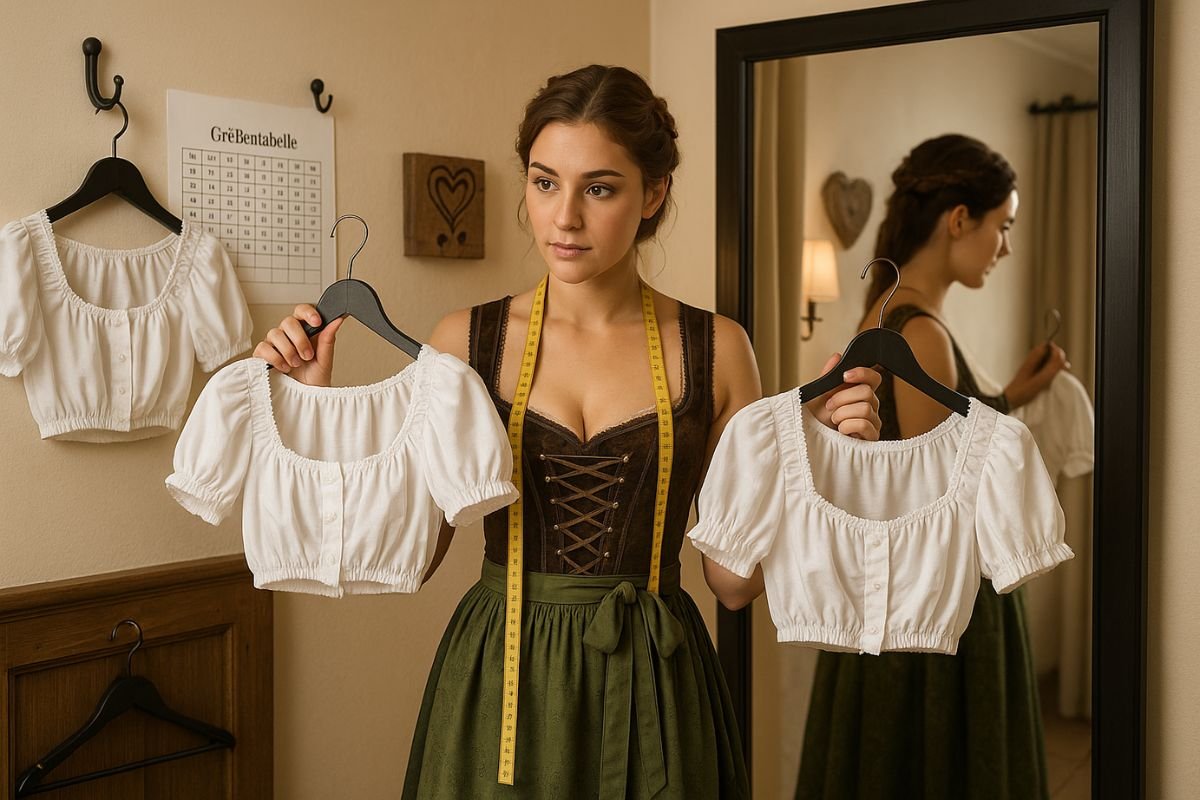
What Dirndl Blouse Size Should I Buy? Complete Sizing Guide
The blouse arrives. You rip open the package, excited. Medium—your usual size in literally everything. You pull it on and immediately know something’s wrong. The bust area gapes oddly while the underbust crushes your ribs like a medieval torture device. The sleeves are somehow both too tight at the shoulders and too loose at the wrists. The neckline sits weird. You ordered your normal size—the size that fits in every other shirt you own—how is this even possible? Welcome to dirndl blouse sizing, where your regular clothing size means almost nothing and European measurements rule everything with unforgiving precision.
Dirndl blouses don’t follow standard American sizing conventions because they’re designed for a completely different fit paradigm—structured, form-fitting garments meant to work with tight bodices rather than standalone pieces. Understanding how to determine your correct blouse size requires knowing which measurements actually matter (bust and underbust, not just “small/medium/large”), how different blouse styles affect sizing needs, what proper fit should look and feel like, and strategic decision-making when caught between sizes. This comprehensive guide walks through the entire blouse sizing process from taking accurate measurements to troubleshooting common fit problems, helping you avoid the frustration of returns and ensuring your blouse complements your dirndl perfectly rather than fighting against it.
Why Dirndl Blouse Sizing Works Differently
Before diving into size charts and measurements, understanding why dirndl blouse sizing operates differently from regular American clothing prevents confusion and sets realistic expectations.
The European Sizing System Foundation
Dirndl blouses use European sizing (32, 34, 36, 38, etc.) based on actual body measurements in centimeters rather than arbitrary size categories (XS, S, M, L) that vary wildly between American brands. European size 38 represents specific bust and underbust measurements that remain relatively consistent across German and Austrian manufacturers, unlike American “Medium” which might mean completely different measurements at different retailers.
This measurement-based system provides more accuracy but requires you to actually know your measurements rather than just grabbing your usual size. You can’t walk into a Trachten shop and say “I’m a Medium”—you need to know your bust circumference in centimeters or inches and match it to the corresponding European size.
Structured Fit vs. Relaxed American Cuts
Traditional dirndl blouses are designed for structured, fitted wear—they’re meant to sit snugly against the body, particularly around the bust and underbust, creating a smooth foundation for the tight dirndl bodice worn over them. This fitted philosophy differs dramatically from modern American casual wear emphasizing comfort, ease, and relaxed silhouettes with generous sizing.
American clothing often includes significant “ease” (extra room for movement and comfort) built into sizing. Dirndl blouses include minimal ease because they’re undergarments worn beneath structured bodices—too much extra room creates bunching, wrinkles, and uncomfortable bulk under the tight bodice. This fundamental difference means your dirndl blouse should feel significantly more fitted than regular shirts, which can feel alarmingly tight if you’re accustomed to American relaxed fits.
The Bodice Relationship
Dirndl blouses don’t exist in isolation—they’re designed specifically to work with dirndl bodices. The bodice compresses the blouse against your body, so the blouse must fit smoothly without excess fabric that bunches or gaps that expose skin inappropriately. This symbiotic relationship means blouse sizing depends partly on your dirndl’s bodice construction, neckline depth, and compression level. For detailed guidance on how foundation garments affect overall fit, see our guide on what bra to wear with a dirndl, which explains how undergarments work together.
Understanding the Measurements That Actually Matter
Dirndl blouse sizing relies on specific measurements—not all body measurements matter equally, and knowing which ones determine fit prevents wasting time on irrelevant numbers.
Bust Circumference: The Primary Determinant
Your bust measurement—the circumference around the fullest part of your chest—is the single most important number for blouse sizing. This measurement determines which European size you need because dirndl blouses must accommodate your bust without crushing it while remaining fitted enough to avoid gaping or excess fabric.
Take this measurement while wearing the bra you plan to wear with your dirndl (different bras create different bust measurements). Wrap the measuring tape around your back and across the fullest part of your bust, keeping the tape level and snug without compressing breast tissue. The number you get in inches or centimeters directly corresponds to size chart ranges.
Underbust: The Secondary Critical Measurement
The underbust measurement—circumference directly beneath your breasts where your bra band sits—affects how the blouse’s bottom edge fits and whether it provides adequate support beneath the dirndl bodice. This measurement matters particularly for blouses with elastic or gathered underbust bands designed to sit securely at this point.
Measure around your ribcage directly under your bust, again keeping the tape level and comfortably snug. This number helps determine whether you’re between sizes (if your bust fits one size but underbust fits another) and which size will provide more comfortable support.
Shoulder Width and Sleeve Length: Secondary Considerations
While less critical than bust measurements, shoulder width affects whether sleeves sit properly or pinch awkwardly at armholes, and sleeve length determines whether long-sleeved styles end at appropriate points on your arms. However, many dirndl blouses feature gathered or puffed sleeves with significant ease, making these measurements less crucial than with regular fitted shirts.
Only measure shoulders and sleeve length if buying long-sleeved or very structured blouses where precise arm fit matters. For typical short-sleeved or gathered-sleeve styles, bust and underbust measurements suffice. For complete measuring guidance including technique and tools, see our detailed guide on how to measure for a dirndl covering the entire measurement process.
How to Actually Use Dirndl Blouse Size Charts
Size charts look straightforward until you try to use them—here’s how to interpret them correctly and make strategic decisions.
Reading European Size Conversions
Most dirndl blouse size charts provide both European sizes (32-54) and approximate US equivalents (XS-3XL), but these conversions are guidelines, not guarantees. European size 38 might be labeled “US 8” on one chart and “US Medium” on another—these variations exist because there’s no standardized US-to-European conversion formula everyone agrees upon.
Always prioritize the actual measurements (bust in inches or centimeters) over the size labels. If the chart shows size 38 fits bust 36-38 inches, and your bust measures 37 inches, you should order size 38 regardless of whether it’s labeled US 8, US Medium, or anything else. The measurement range matters; the letter/number designation is just a reference label.
Understanding Measurement Ranges
Size charts typically show ranges rather than single numbers—for example, “Size 38: Bust 90-94cm” or “Size M: Bust 36-38 inches.” If your measurement falls within a range, that’s your size. However, where you fall within the range affects fit tightness:
- Lower end of range: If your bust is 36 inches and the size fits 36-38 inches, the blouse will fit on the snugger side—potentially very snug if the manufacturer runs small or uses non-stretch fabric.
- Middle of range: Your bust at 37 inches in a 36-38 inch range typically provides the most balanced fit—snug but not crushing, with minimal gaping.
- Upper end of range: At 38 inches in a 36-38 inch range, you’ll have slightly more room, which might be preferable if you want comfort over maximum structure or if you’re between sizes in other measurements.
Brand-Specific Variations
Different dirndl blouse manufacturers interpret sizes slightly differently—some run true to size, others run small (particularly traditional Bavarian brands prioritizing very fitted silhouettes), and some run large (often modern brands adapting for American customers expecting more generous sizing).
Always check customer reviews mentioning whether a specific brand or blouse “runs small” or “runs large.” If multiple reviews mention sizing issues, believe them and adjust your order accordingly. When reviews are unavailable, ordering from retailers with good return policies provides safety net for sizing experiments.
What Proper Dirndl Blouse Fit Looks and Feels Like
Understanding correct fit prevents mistaking appropriately snug traditional fit for “too small” or accepting actually poor fit as “how it’s supposed to be.”
Visual Fit Indicators
At the bust: The blouse should follow your bust shape smoothly without compressing it flat (too tight) or leaving gaps where fabric floats away from your body (too loose). The fabric should lie against your skin with minimal wrinkling or pulling. If wearing a square or sweetheart neckline blouse, the neckline edge should sit flat against your chest without gaping open or digging uncomfortably into breast tissue.
At the underbust: If the blouse has elastic or gathering at the underbust, it should sit comfortably at your ribcage without rolling up or cutting in painfully. The band should feel secure—you shouldn’t need to constantly pull the blouse down—but shouldn’t restrict breathing.
At the shoulders: Shoulder seams (if present) should sit at the actual edge of your shoulders, not drooping onto your upper arms (too large) or pulling toward your neck (too small). Puffed or gathered sleeves should sit comfortably at armholes without pinching when you raise your arms.
Overall appearance: The blouse should create smooth lines without obvious wrinkles, pulling, or excess fabric bunching. When you put your dirndl bodice on over the blouse, the blouse shouldn’t create uncomfortable bulk or visible lumps under the tight bodice.
Physical Feel Indicators
Correct fit feels snug but not restrictive—you should be able to breathe deeply, raise your arms fully, and move comfortably without the blouse shifting position or creating uncomfortable pressure points. The blouse should feel like a supportive layer, almost like wearing a structured tank top, rather than a loose shirt.
However, if you feel squeezed, can’t take deep breaths without fabric straining, notice red marks forming where fabric digs in, or experience numbness or tingling (indicating circulation restriction), the blouse is genuinely too small regardless of what the size chart suggested. Dirndl blouses should be fitted, not torturous.
Body Type Specific Sizing Strategies
Different body proportions require different sizing approaches—understanding your body type helps predict which sizes will work best and which adjustments might be necessary.
Body Type Sizing Recommendations
| Body Type | Common Fit Challenges | Sizing Strategy | Best Blouse Styles |
|---|---|---|---|
| Petite/Small Frame | Blouses too long, shoulders too wide, excess fabric bunching | Choose smallest size that fits bust; consider cropped or short-style blouses; may need hemming | Short-length blouses, simple styles without excessive gathering |
| Fuller Bust | Bust fits but underbust/waist too loose; gaping necklines; fabric strain at bust | Size for bust measurement; accept looser underbust or add darts; choose stretch fabrics | Styles with adjustable lacing, stretch panels, or underwire support |
| Athletic/Straight | Blouse fits bust but looks boxy; limited waist definition; gaping at underbust | Size for bust; choose styles with waist definition or elastic underbust bands | Elastic or gathered underbust styles creating shape; avoid very loose fits |
| Plus-Size | Limited size availability; fit varies wildly between brands; comfort vs. structure balance | Seek brands offering extended sizes; prioritize comfort; consider stretch fabrics | Stretch-blend fabrics; adjustable closures; generous cut styles |
| Long Torso | Standard blouses too short; rides up under bodice; uncomfortable pulling | Look for “long” or “tall” styles; size up for length; check blouse length measurements | Longer-cut blouses; avoid very cropped styles; check length specifications |
| Short Torso | Blouses too long; bunches under bodice; excess fabric | Choose cropped styles; may need hemming; smaller sizes often shorter | Cropped or short-length styles; petite-specific sizing when available |
Working With Your Proportions
Most bodies don’t fit perfectly into single size chart boxes—you might have a fuller bust with a smaller underbust, broad shoulders with a smaller bust, or any number of proportion variations. In these cases, always size for your largest measurement (typically bust) and plan for minor alterations or adjustments elsewhere rather than choosing a size that’s too small in critical areas.
Strategic Decision-Making When Between Sizes
Being between sizes is extremely common—your measurements don’t always align neatly with size chart boundaries, requiring strategic choices about sizing up or down.
Between-Sizes Decision Framework
| Your Situation | Size Up If… | Size Down If… | Recommended Approach |
|---|---|---|---|
| Bust at size boundary | You prefer comfort, will wear all day, or have fuller bust | You want very fitted look, wearing for photos only, or fabric has stretch | Generally size up for comfort and versatility |
| Between measurements | Blouse is non-stretch fabric (cotton, linen) | Blouse has significant stretch or elastic panels | Match fabric type to sizing strategy |
| Reviews say “runs small” | Multiple reviews confirm; you’re already at upper range | Only one or two reviews; you prefer very snug fit | Trust consistent review feedback over size chart |
| Different sizes for bust/underbust | Bust measurement more important for your blouse style | Underbust fit matters more (elastic band style) | Prioritize whichever measurement affects primary fit |
| Uncertain about fit | First dirndl blouse purchase; unsure about preference | You’ve worn dirndls before; know you prefer fitted | Size up for first purchase; refine in future orders |
The Size-Up Philosophy
When genuinely uncertain, sizing up proves safer than sizing down for dirndl blouses. A slightly loose blouse can be taken in through simple alterations (adding darts, taking in side seams) or simply accepted as more comfortable, while a too-small blouse often cannot be meaningfully enlarged and remains unwearably uncomfortable. Additionally, too-tight blouses under tight dirndl bodices create extremely uncomfortable double compression many people find intolerable for all-day wearing.
Troubleshooting Common Blouse Fit Problems
Even with careful sizing, fit issues sometimes occur—knowing how to identify and fix common problems prevents frustration.
Fit Problem Solutions Guide
| Problem | Likely Cause | Immediate Fix | Long-Term Solution |
|---|---|---|---|
| Neckline gapes open | Bust too small for blouse; wrong neckline style for your bust shape | Safety pin from inside; fashion tape | Size down or choose different neckline style |
| Fabric strains at bust | Blouse too small in bust area; non-stretch fabric | Leave top closure undone if possible | Size up; choose stretch fabric blouses |
| Underbust elastic too tight | Sized too small; elastic too aggressive | Clip elastic slightly from inside (careful!) | Size up or choose non-elastic styles |
| Sleeves too tight | Shoulder width too narrow; fitted sleeve style | Remove from blouse if detachable | Size up or choose gathered-sleeve styles |
| Blouse too long | Standard sizing on petite frame; long-style blouse | Tuck excess inside bodice waistband | Hem blouse or buy petite-specific sizing |
| Blouse too short | Sized too small; standard sizing on tall frame | Wear under higher-waisted bodice | Size up or seek tall-specific sizing |
| Bunching under bodice | Blouse too large; excess fabric | Smooth carefully when putting bodice on | Size down or take in side seams |
| Uncomfortable all-over tightness | Sized too small overall; non-stretch fabric | None—requires different size | Size up; choose stretch fabrics |
When to Return vs. Alter vs. Accept
Return the blouse if: It’s uncomfortably tight overall, creates painful pressure points, restricts breathing or movement, or has irreparable fit issues (way too small, way too large, wrong proportions entirely). Don’t try to force genuinely wrong sizing to work.
Alter the blouse if: It’s close to correct but needs minor adjustments (slightly too long, small gaps fixable with darts, sleeves needing shortening). Simple alterations cost €15-€40 and can perfect otherwise good fits.
Accept the fit if: It’s comfortable and functional even if not perfectly fitted (slightly loose but not sloppy, slightly snug but not painful). Perfect fit is ideal but “good enough” often suffices for festival wear.
How Different Blouse Styles Affect Sizing Needs
Not all dirndl blouses are created equal—different styles have different fit requirements and sizing considerations.
Neckline Styles and Sizing Impact
Square necklines: These structured necklines require precise sizing because they either lie flat against your chest (correct) or gape open (too large) or dig uncomfortably into breast tissue (too small) with little middle ground. If between sizes, stick with your measured size rather than sizing up.
Sweetheart necklines: The curved shape accommodates slight size variation better than square necks—they’re more forgiving of between-size situations. These work well if you’re uncertain about sizing.
Off-shoulder styles: These must be small enough to stay up (they rely on tightness to prevent sliding down) but large enough to allow shoulder movement. Often require sizing down for security unless they have elastic keeping them positioned.
High-collar styles: Less critical sizing at the neckline (covered by fabric rather than exposed), but collar must fit comfortably around neck without choking or gaping.
Sleeve Styles and Fit Flexibility
Puffed or gathered sleeves: Very forgiving—the gathering provides ease accommodating various arm sizes. Between-size situations work fine with these styles.
Fitted long sleeves: Require accurate shoulder and arm measurements. Less forgiving of sizing errors—too small restricts movement, too large looks sloppy.
Sleeveless or cap sleeve: Focus entirely on bust and underbust fit without sleeve complications. Often easier to size correctly.
Support Structure Variations
Underwire or padded blouses: Size according to your bra size basically—if you wear 34D, you need blouse sizing accommodating that bust volume. These structured styles offer less sizing flexibility.
Soft, unstructured blouses: More forgiving of slight sizing variations. The lack of rigid structure means they adapt somewhat to your body rather than demanding your body adapt to them.
Elastic or stretch-panel blouses: Most forgiving of all—the stretch accommodates between-size situations and slight measurement variations. Good choice if uncertain about sizing.
When and How to Alter Dirndl Blouses
Sometimes alterations provide better solutions than returning and re-ordering, particularly for minor fit issues on otherwise good blouses.
Common Alterable Issues
Blouse too long: Hemming blouses costs €15-€25 and takes 1-2 weeks typically. Simple alteration any competent seamstress can handle. Bring your dirndl bodice to the fitting so the seamstress can see exactly where the blouse should end.
Gaping neckline: Adding small darts at bust or taking in center front seam can eliminate gaping. Costs €20-€35 depending on complexity. More involved than hemming but achievable.
Too loose at underbust: Taking in side seams or adding elastic to underbust band tightens fit. Costs €25-€40. Relatively straightforward alteration.
Sleeves too long: Shortening sleeves costs €20-€30 per sleeve. Simple alteration though somewhat time-consuming due to detail work on gathered or trimmed sleeves.
What Can’t Be Easily Altered
Don’t attempt altering: blouses that are too small overall (can’t add fabric that doesn’t exist), structured underwire blouses (altering changes support structure), heavily decorated blouses where alterations would damage embroidery or lace, or blouses needing extensive reconstruction (at that point, wrong size entirely).
Finding Qualified Alterations Tailors
Not all seamstresses are familiar with dirndl construction. Seek tailors with experience in traditional German clothing, costume alteration, or historical garment work. Explain exactly what you need and why—show them your dirndl so they understand the blouse’s purpose and how it will be worn. For comprehensive guidance on evaluating quality construction before purchase, see our guide on how to buy a dirndl covering quality assessment that also applies to blouse selection.
Brand-Specific Sizing Considerations
Different manufacturers approach sizing differently—knowing these variations helps set expectations and make better ordering decisions.
Traditional Bavarian Brands
Authentic German and Austrian brands (Spieth & Wensky, Krüger, Stockerpoint, etc.) typically run true to European size charts but with very fitted, structured cuts. These brands rarely compromise on traditional fitted styling, meaning their blouses feel snugger than American customers might expect. If between sizes with traditional brands, size up unless you specifically want very fitted results.
Modern International Brands
Contemporary brands producing dirndls for international markets often adjust sizing to accommodate American expectations of more generous fits. These may run slightly large compared to size charts or include more stretch fabric. Customer reviews usually indicate this—look for comments like “runs large” or “very stretchy.”
Budget vs. Premium Brands
Budget brands often use simplified sizing (just S/M/L instead of numbered European sizes) with less precise fit. These fit ranges are broader—their Medium might accommodate anyone from size 36-40 European. Premium brands offer more granular sizing (individual sizes 32, 34, 36, 38) providing better fit precision for specific measurements.
Practical Sizing Strategies and Pro Tips
Beyond charts and measurements, practical wisdom from experienced dirndl wearers helps navigate sizing successfully.
The Two-Size Strategy
If ordering online from retailers with free returns (or affordable return shipping), consider ordering two sizes—your measured size and one size up. Try both, keep the better fit, return the other. This costs nothing except time and eliminates sizing uncertainty. Particularly valuable for first dirndl blouse purchase when you don’t yet know your preferences.
Customer Review Mining
Read customer reviews obsessively, specifically looking for: comments about sizing accuracy (“runs small,” “runs large,” “true to size”), mentions of specific measurements and which size fit (e.g., “36-inch bust, ordered Medium, perfect fit”), photos showing fit on real bodies (not models), and feedback about fabric stretch or structure affecting fit.
Pay special attention to reviewers with similar measurements to yours—if someone your size says it fit perfectly or terribly, that’s valuable data worth more than generic size charts.
Fabric Composition Checking
Before ordering, verify fabric content. Blouses listing “95% cotton, 5% elastane” or “stretch cotton blend” provide significantly more sizing forgiveness than “100% cotton” which has zero stretch. If uncertain about sizing and choosing between two similar blouses, select the one with some stretch content—it’ll accommodate slight measurement variations or between-size situations better.
Time Your Purchase Strategically
If possible, order blouses well before you need them (8-12 weeks before Oktoberfest rather than 2 weeks). This provides time for: receiving the order, trying on, returning if needed, waiting for replacement, potential alterations if necessary. Last-minute ordering eliminates this flexibility, forcing you to accept whatever fits rather than optimizing fit.
Frequently Asked Questions About Dirndl Blouse Sizing
What size dirndl blouse should I buy if I’m a US size 8?
Don’t use your US dress size—use your actual bust measurement instead. Measure around the fullest part of your chest in inches, then match that number to a size chart. US size 8 might be European 36, 38, or 40 depending on your bust measurement and the brand. Most women who wear US 8 have bust measurements of 35-38 inches, which typically corresponds to European sizes 36-40, but measuring ensures accuracy.
Should dirndl blouses feel tight or have room?
Dirndl blouses should feel snug but not restrictive—think fitted tank top, not compression garment. You should be able to breathe deeply, raise your arms, and move comfortably without fabric straining or gaping. The blouse should follow your body shape smoothly but shouldn’t create pressure points or leave red marks. If you’re used to relaxed American fits, proper dirndl blouse fit will feel tighter than you’re accustomed to, but it shouldn’t be painful.
Do dirndl blouses run small compared to American sizes?
Yes, generally they do. European sizing is based on actual body measurements and assumes minimal ease (extra room), while American sizing includes significant ease for comfort. A European size 38 dirndl blouse will feel significantly more fitted than a US Medium casual shirt even if they’re theoretically equivalent sizes. This is intentional design, not a sizing error. Size according to measurements, not assumptions about equivalent sizes.
What if I’m between two sizes on the chart?
Size up in most cases. A slightly loose blouse is more comfortable and can be altered if needed, while a too-small blouse can’t be meaningfully enlarged and will be uncomfortable under a tight dirndl bodice. The exception: if the blouse has significant stretch fabric or elastic, you can consider sizing down if you want a very fitted look. When in doubt, size up for first purchase and adjust future orders based on actual fit experience.
Can I alter a dirndl blouse if it doesn’t fit perfectly?
Yes, for minor issues. Hemming length, taking in sides, shortening sleeves, or adding small darts are straightforward alterations costing €15-€40. However, you can’t make a too-small blouse larger (no fabric to add), and heavily restructuring blouses becomes expensive quickly. Alterations work best for blouses that are close to correct but need small adjustments, not for fundamentally wrong sizing.
How do I know if my dirndl blouse is too small?
Clear signs include: fabric straining or pulling across the bust creating stress lines, inability to breathe deeply without uncomfortable pressure, red marks or indentations where fabric digs in after wearing, neckline or armholes cutting into skin, closures gaping or unable to fasten, or overall discomfort after 10-15 minutes of wear. If you’re experiencing any of these issues, the blouse is too small regardless of what size chart suggested.
What measurements do I absolutely need for dirndl blouse sizing?
At minimum, you need your bust measurement (around the fullest part of your chest) in inches or centimeters. Ideally also measure your underbust (directly beneath your bust). These two measurements determine which size you need. Shoulder width and sleeve length are helpful for long-sleeved or structured styles but less critical for typical short-sleeved gathered styles. Measuring while wearing the bra you’ll wear with the dirndl ensures accuracy.
Can I wear a regular blouse instead of a dirndl blouse?
It won’t work well. Regular blouses aren’t designed for the tight compression of dirndl bodices—they’ll bunch uncomfortably underneath, create lumps under the fitted bodice, or have necklines that don’t coordinate properly with dirndl neckline styles. Additionally, regular blouses often have too much fabric or wrong sleeve styles for dirndl wearing. Dirndl-specific blouses are engineered for this purpose; regular blouses are not. For understanding how all dirndl components work together, see our guide on what to wear with a dirndl covering complete outfit assembly.
Do I need a different size blouse than my dirndl size?
Possibly. Dirndls are sized based on bust, waist, and hip measurements, while blouses primarily use bust and underbust. If you have proportional measurements, your dirndl and blouse sizes will likely match (both size 38, both size 40). However, if you have different proportions—larger bust with smaller waist, or vice versa—you might need different sizes. Size each piece independently based on its specific measurement requirements rather than assuming they’ll match.
How much should I spend on a dirndl blouse?
Budget €25-€40 for acceptable basic blouses, €40-€70 for quality traditional blouses with proper construction and natural fabrics, or €70-€150+ for premium designer blouses with elaborate details. For one-time Oktoberfest attendance, budget options suffice. For regular wearing or important events, mid-range investment (€50-€80) provides significantly better quality, fit, and longevity. Match blouse quality to dirndl quality—don’t pair a €500 designer dirndl with a €20 blouse.
Finding Your Perfect Dirndl Blouse Fit
Dirndl blouse sizing frustrates many first-time buyers because it requires abandoning familiar American sizing assumptions and learning a measurement-based European system prioritizing fit precision over comfort ease. However, once you understand which measurements actually matter (bust and underbust primarily), how to interpret size charts correctly (focus on measurement ranges, not letter sizes), and strategic decision-making for between-size situations (size up when uncertain), the process becomes straightforward rather than mysterious.
The key is accepting that dirndl blouses should fit differently than regular American clothing—snugger, more structured, designed to work with tight bodices rather than as standalone pieces. This fitted approach feels uncomfortable initially if you’re accustomed to relaxed contemporary fits, but it’s intentional design creating the traditional silhouette dirndls are known for. A properly fitted dirndl blouse enhances comfort and appearance rather than detracting from either, supporting your bust appropriately while creating smooth lines under the dirndl bodice.
Whether you’re buying your first blouse or refining fit after previous purchases, investing time in accurate measurements, careful size chart interpretation, and honest fit assessment prevents the frustration of returns and ensures your blouse complements your dirndl perfectly. For those assembling complete traditional wardrobes, explore quality dirndl blouses and Bavarian traditional dirndl dresses worthy of proper sizing investment.
Measure carefully, size strategically, and wear your perfectly fitted dirndl blouse with confidence!

Anna Bauer is a seasoned Bavarian fashion expert, cultural consultant, and heritage stylist with over a decade of hands-on experience in traditional German clothing. Born in Munich, the heart of Bavaria, Anna grew up surrounded by the rich traditions of Trachten fashion. Her passion for cultural attire led her to pursue a degree in Fashion and Textile Design at the prestigious University of the Arts Berlin, where she specialized in European folkwear.
Over the past 12+ years, Anna has collaborated with renowned Trachten designers, styled outfits for Oktoberfest events across Germany, and contributed articles to top fashion and culture magazines across Europe. Her work focuses on preserving the authenticity of Lederhosen and Dirndl wear while helping modern audiences style them with confidence and flair.
As the lead content contributor for German Attire, Anna combines her academic background, professional styling experience, and deep cultural roots to provide readers with valuable insights into traditional German fashion. Her blog posts cover everything from historical origins and styling guides to care tips and festival outfit planning—making her a trusted voice for anyone looking to embrace Bavarian heritage in a stylish, modern way.