Get 5% Off – Use promo code German Attire


What Do German People Look Like? A Fact-Checked Guide to Features, Diversity and Dress
What Do German People Look Like? A Fact-Checked Guide to Features, Diversity and Dress
Key takeaways
- There is no single German appearance. Germany has never been genetically or visually uniform.
- Around 39.6% of people in Germany have blue eyes, meaning roughly six in ten do not.
- Almost a third of the population has a migration background, according to 2025 federal statistics.
- The claim that Germans share a distinctive square jaw and high cheekbones comes from outdated racial anthropology, not modern science.
- What people actually recognise as German is usually clothing, grooming and style, not facial structure.
The short answer
People in Germany look like people anywhere in Central Europe: extremely varied. Light hair and blue eyes are more common in Germany than in most of the world, but they are a minority-to-plurality trait rather than a defining one. Modern Germany is one of Europe’s most demographically mixed countries, and the visual signals that make someone read as German abroad are far more about dress and self-presentation than about bone structure.
The rest of this guide separates what the evidence supports from what it does not, and then explains the part almost every other article skips: the clothing.
Is there really a German look?
No, and there never was one. Germany only became a unified country in 1871. Before that it was hundreds of separate territories, sitting at the crossroads of Northern, Western, Central and Eastern Europe. Migration across those regions was constant for two thousand years.
Genetic research bears this out. Studies of the German population have found only a minor degree of structure between the north and south of the country, and European genetic variation generally follows a smooth geographic gradient rather than stopping at national borders. Put plainly: a person from Hamburg is genetically closer to someone in Denmark than to someone in Munich, and a person in Munich is closer to someone in Austria than to someone in Hamburg. National borders are political lines, not biological ones.
This matters for how you read the rest of this article. Everything below describes statistical tendencies across a population of 83 million people, not a template that any individual German fits.
What the data actually says about physical traits
Eye colour in Germany
Blue is the most common single eye colour in Germany at roughly 39.6%, but it is not the majority. Around a third of people have intermediate eyes, meaning green, hazel or grey, and just over a quarter have brown eyes.
A widely cited 2019 review in Forensic Science International: Genetics compiled eye-colour prevalence across Europe. Germany’s distribution is notably balanced compared with its northern neighbours.
| Country | Blue | Intermediate (green, hazel, grey) | Brown |
|---|---|---|---|
| Iceland | 74.5% | 14.2% | 9.2% |
| Denmark | 64.8% | 20.5% | 14.6% |
| Netherlands | 60.9% | 17.4% | 21.7% |
| Poland | 52.5% | 12.5% | 35.0% |
| Great Britain | 42.8% | 25.5% | 31.8% |
| Germany | 39.6% | 33.2% | 27.2% |
| France | 22.0% | 44.0% | 34.0% |
The pattern worth noticing is that Germans are only slightly more likely to have blue eyes than intermediate or brown eyes. Germany sits mid-table in Europe, well below Denmark and Iceland. Roughly three in ten people in Germany have brown eyes, a figure that rarely appears in articles about typical German features.
For global context, brown eyes account for an estimated 70 to 79% of the world’s population, with blue a distant second at 8 to 10%.
Hair colour
Blond hair is common in Germany but not dominant, and definitions vary enormously depending on where you draw the line between dark blond and light brown. The same 2019 review found that blond hair was prevalent in Germany and the Netherlands, with the Netherlands recording the highest share at 71.45%.
What is much clearer is the rarity of red hair. Red hair prevalence was lowest in Germany at around 0.2%, compared with 8.44% in Great Britain. This is the single most reliable pigmentation difference between the two countries, and one almost nobody mentions.
A practical note: many German adults who were blond as children darken to mid-brown by their twenties. Childhood blondness that fades is extremely common across Northern and Central Europe, which distorts both self-reporting and the stereotype.
Skin tone
Light skin is common in Germany, as it is across all of Northern and Central Europe. This reflects a long adaptation to low ultraviolet levels at higher latitudes and is shared with Poland, the Netherlands, Denmark, the Czech Republic and Austria alike. It is a regional trait, not a national one.
Today, skin tone across Germany spans the full range. That is a straightforward consequence of six decades of immigration, which the demographics section below covers.
Height and build
The average adult in Germany is 1.73 m tall. German men average 1.79 m, about 5 feet 10.5 inches, and German women 1.66 m, about 5 feet 5 inches, according to the 2025 Mikrozensus.
| Measure | Men | Women | All adults |
|---|---|---|---|
| Average height | 1.79 m (5 ft 10.5 in) | 1.66 m (5 ft 5 in) | 1.73 m |
| Average weight | 86.5 kg | 69.7 kg | 78.3 kg |
Average height has been broadly flat in recent years: 1.73 m in 2025, 1.73 m in 2021 and 1.72 m in 2017. Average weight has crept upward from 77.0 kg in 2017.
Age makes a visible difference. The tallest age group is 18 to 24-year-olds at an average 1.75 m, while those aged 75 and over average 1.68 m. That seven-centimetre gap was driven by twentieth-century improvements in childhood nutrition.
Germany is tall by global standards but not the tallest in Europe. The Netherlands leads, with Dutch men averaging roughly 4 to 5 cm more than German men. If you have heard that German men average over six feet, that is simply false. The real figure is around 5 feet 10.5 inches.
One caveat worth knowing: the Mikrozensus relies on self-reported figures, and research consistently finds men overstate their height by around a centimetre. Measured surveys tend to come in slightly lower. This is also why generic size charts mislead so often, and why our Trachten size guide works from measured body dimensions rather than national averages.
Why typical German facial features is a myth
Search this topic and you will find the same list repeated across dozens of sites: square jaw, high cheekbones, straight nose, wide forehead, pointed chin, sometimes described as a Teutonic profile.
None of this is supported by anthropological or genetic research. It is worth understanding where it actually comes from.
The 19th-century origin
That vocabulary descends directly from nineteenth-century physical anthropology, which attempted to sort European populations into types by measuring skulls, jaws and noses. The entire framework, including the term Teutonic as a facial category, was abandoned by mainstream science decades ago because it failed on its own terms. Researchers could not reliably assign individuals to national categories from facial measurements, because the variation within any European population is far larger than the variation between populations.
What survives today is the vocabulary, recycled through content sites that copy one another without checking the source.
Why European faces do not stop at borders
Facial morphology in Europe varies gradually across geography. There is no measurable line where Dutch faces end and German faces begin, or where German becomes Polish, Czech or Austrian. Population genetic studies of Europe consistently find that genetic variation forms a continuous gradient tracking geography, with the strongest differentiation running north to south across the continent as a whole, not clustering into nations.
Within Germany itself, the detected structure is minimal. A person in Schleswig-Holstein carries genetic signals reflecting centuries of contact with Denmark. A person in Saxony reflects contact with Poland and Bohemia. A person in Baden-Württemberg reflects contact with France and Switzerland. Germany is the overlap zone, not a distinct pool.
The history that made the stereotype global
There is a reason the blond hair, blue eyes image of Germany is so unusually fixed in global culture, and it is not a flattering one.
Nazi racial ideology promoted a specific physical ideal as the supposed marker of German identity, and built an enormous propaganda apparatus around it. That imagery was then reproduced for decades in films, war media and popular culture worldwide, including by the Allies. The result is that a fringe political fiction became the default international mental image of an entire country.
Most Germans are acutely aware of this. It is a significant part of why the question of what a German looks like is treated with more discomfort inside Germany than outside it, and why framing appearance as a marker of nationality lands badly there. If you are writing, designing or marketing for a German audience, this is useful context to hold.
What modern Germany actually looks like
Around 31% of people in Germany have a migration background. This is the single most important fact about German appearance today, and the one most articles either omit or under-report.
According to Germany’s Federal Statistical Office, Destatis, the 2025 microcensus recorded the following for the population in private households.
| Category | People (2025) | Share |
|---|---|---|
| Total population in private households | 82.74 million | 100% |
| Without migration background | 56.97 million | 68.9% |
| With migration background (wider definition) | 25.77 million | 31.1% |
| With migration background (narrower definition) | 23.40 million | 28.3% |
The trend matters as much as the number. In 2005 the figure stood at 14.4 million. Two decades later it has risen to 25.8 million, an increase of nearly 80%.
Germany’s largest heritage communities include people of Turkish, Polish, Russian, Syrian, Italian, Romanian, Ukrainian and Kazakh background, among many others. In major cities the share is considerably higher than the national average. In parts of Berlin, Frankfurt, Offenbach, Duisburg and Munich, residents with a migration background are close to half the population or more.
A German national football squad is probably the clearest public illustration. For over two decades, German teams have fielded players of Turkish, Ghanaian, Tunisian, Polish, Spanish and Bosnian heritage as a matter of routine. That is what a representative cross-section of young German adults looks like.
There is a practical implication here. If you are casting models, choosing stock imagery or designing marketing aimed at Germany, a cast of exclusively blond, blue-eyed people does not read as authentically German to a German audience. It reads as a foreigner’s idea of Germany, and often as a slightly uncomfortable one.
Regional differences inside Germany
Regional variation is real but far milder than commonly claimed. It is best understood as a gradient shaped by geography and neighbouring populations.
| Region | Neighbouring influence | What is actually observable |
|---|---|---|
| North (Schleswig-Holstein, Hamburg, Lower Saxony) | Denmark, Netherlands | Slightly higher frequency of lighter pigmentation and taller average stature |
| East (Saxony, Brandenburg, Mecklenburg) | Poland, Czechia | Blends into West Slavic populations with no sharp visual boundary |
| West (North Rhine-Westphalia, Rhineland) | Netherlands, Belgium, France | Most industrially diverse, with the highest historical labour migration |
| South (Bavaria, Baden-Württemberg) | Austria, Switzerland, Czechia | Marginally higher frequency of darker hair than the north |
| Southwest (Saarland, Rhineland-Palatinate) | France | Long-running French cultural and population exchange |
Two honest caveats apply. First, these tendencies are weak, weak enough that no one can reliably identify a German’s home region from a photograph. Second, regional dress traditions differ far more visibly than regional appearance, which is where the next section comes in.
So why do people say he looks German?
Here is the part that other articles miss entirely. When someone abroad identifies a person as German, they are almost never reading facial structure. They are reading style signals, and those signals are genuinely distinctive.
Ask Germans themselves how they spot a compatriot abroad and you get remarkably consistent answers. None of them involve cheekbones.
| Signal | What it looks like | Why it reads as German |
|---|---|---|
| Functional outerwear | Technical shell jackets, softshells, outdoor-brand logos | Outdoor-wear brands are mainstream daily clothing in Germany, not niche sportswear |
| Practical footwear | Sturdy walking shoes, trekking sandals, well-built leather boots | Durability and comfort are prioritised strongly over fashion signalling |
| Understated colour palette | Navy, grey, olive, black, earth tones | Loud colour and visible branding are culturally read as showy |
| Distinctive eyewear | Architectural, geometric or boldly coloured frames | Glasses are treated as a design object, the one area where restraint relaxes |
| Backpack over handbag | Practical daypacks worn by adults of all ages | Function-first logic applied to everyday carrying |
| Scarf worn year-round | Lightweight scarves well outside winter | A near-universal German styling habit |
| Minimal grooming | Little or no visible makeup, natural hair | Heavy grooming reads as inauthentic in much of German social culture |
| Personal space and posture | Larger conversational distance, reserved body language | A consistent cross-cultural finding, easily visible in public settings |
These signals are acquired, not inherited. A person of any background who grew up in Germany will display most of them. A person of German descent who grew up in Texas or Sydney will display almost none. That alone tells you where the German look actually lives.
Trachten: the one look that genuinely is German
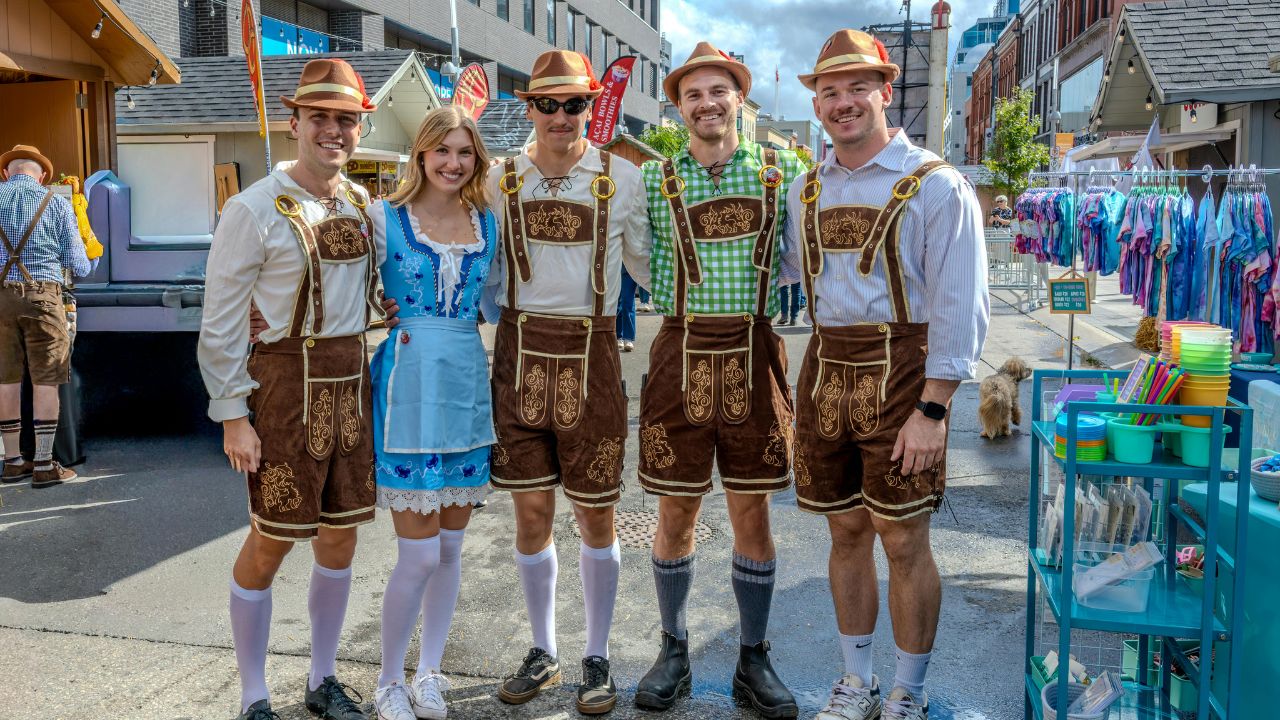
If there is a visual identity that is authentically and specifically German, it is regional traditional dress, known as Tracht. Unlike facial features, this is real, documented, regionally precise and still worn today.
Tracht is the German term for traditional regional clothing. Trachten is its plural. The two best-known garments internationally are the Dirndl and Lederhosen, both originating in the Alpine south rather than Germany as a whole.
The Dirndl
The Dirndl is a women’s garment built from four components: a fitted bodice, a blouse worn beneath it, a full skirt, and an apron. It developed from Alpine working dress in Bavaria and Austria and was adopted as fashionable clothing in the nineteenth century.
Details carry meaning. Bodice construction, skirt length, fabric weight and apron material all vary by region and by occasion. A heavy wool winter Dirndl and a light cotton summer Dirndl are different garments for different purposes. The blouse underneath is a garment in its own right, and the neckline you choose changes the whole silhouette, which is why our range of Trachten blouses covers the main traditional cuts.
The best-known convention concerns the apron bow. Traditionally, tied on the wearer’s left it signals single. On the right it signals taken. At the centre front it indicates a virgin or a child, and at the centre back a widow or serving staff. This convention is genuinely observed in Bavaria and Austria, though younger wearers treat it more loosely than tradition dictates.
Lederhosen
Lederhosen are leather breeches, historically made from deer, goat or cowhide, worn with H-shaped braces and a decorated front flap. They were practical working garments for Alpine labourers before becoming formal regional dress.
Length distinguishes the main types. Short Lederhosen sit above the knee. Kniebundhosen, the knee-length version, are generally considered the more formal option. Genuine leather darkens and moulds to the wearer over years, and a well-worn pair is valued precisely because it shows its age, which is the opposite of how most modern clothing is judged.
The full outfit is rarely just the breeches. A Trachten shirt, a waistcoat, and the right accessories such as braces, belt, Haferl shoes and Loferl socks are what separate traditional dress from fancy dress.
Regional variation beyond Bavaria
This is where most English-language coverage stops, and it is a significant gap. Tracht exists across the German-speaking world, and Bavarian dress is only one tradition among many.
| Region | Characteristic dress |
|---|---|
| Bavaria (Oberbayern) | Lederhosen, Dirndl, Loden jackets, Gamsbart hats |
| Black Forest (Schwarzwald) | Bollenhut, the distinctive red or black pompom hat |
| Schwalm (Hesse) | Short pleated skirts with layered petticoats and small caps |
| Frisia and the North Sea coast | Dark fabrics, heavy silver jewellery, lace caps |
| Spreewald (Brandenburg) | Sorbian dress with elaborate embroidered headscarves |
| Swabia | Loden and linen with restrained ornamentation |
Who wears Tracht today
A common misconception is that Tracht is a costume worn only for tourists. In Bavaria and Austria it functions as genuine formal wear. It appears at weddings, church services, village festivals, trade fairs and, in Bavarian political and business life, at serious public events.
Outside the south, most Germans own no Tracht at all and may wear it only for Oktoberfest-themed occasions. This regional split is worth understanding. Tracht is authentically German, but it is not universally German, and a Hamburger in Lederhosen is as much in fancy dress as a Londoner in a kilt.
How Germans dress day to day
Away from festivals, everyday German dress is defined by three principles: function, durability and restraint.
- Quality over quantity. Smaller wardrobes of better-made items are the norm. A good coat is expected to last years, not a season.
- Weather-led, not trend-led. Layering is standard. Germans dress for the forecast with a consistency visitors often find striking.
- Understatement over display. Conspicuous branding and overt luxury signalling are culturally read as poor taste in most social contexts.
- Comfort in public life. With high rates of cycling, walking and public transport use, clothing has to work for a commute that involves actual movement.
- Softer formality codes. German offices skew less formal than British or American equivalents in many sectors, but less formal means neat and considered, not casual.
Regional and urban differences do exist. Berlin skews toward black, secondhand and deliberate anti-fashion. Munich and Düsseldorf are visibly more polished and label-conscious. Hamburg leans nautical and restrained. Smaller towns are practical and conservative.
What this means if you are buying German clothing
If you have come to this topic because you are buying Trachten, a few practical points follow directly from everything above.
Authenticity lives in construction, not in appearance. No one needs to look a particular way to wear Tracht correctly. What matters is whether the garment itself is properly made: a lined and boned Dirndl bodice rather than a printed costume-shop imitation, real leather rather than coated fabric, and proper hardware rather than plastic.
Regional accuracy is worth knowing. A Bavarian Dirndl and a Black Forest Tracht are not interchangeable, and getting this right signals genuine respect for the tradition rather than treating it as generic German costume.
Fit is the real difference between traditional dress and costume. A Dirndl is fitted through the bodice and cut to sit at a specific point on the waist. Lederhosen are worn close and broken in over time. Loose, ill-fitting versions read immediately as novelty wear. If you fall between standard sizes, which given the height data above a great many people do, made-to-measure Trachten solves the problem properly rather than approximately.
Tracht suits every build and every complexion. This is the practical conclusion of the entire article. Traditional German dress was made for working people of every shape across several centuries. It has never depended on the wearer having any particular colouring, which is exactly why Bavarians of Turkish and Italian heritage wear it at Oktoberfest without a second thought.
Frequently asked questions
Do most Germans have blonde hair and blue eyes?
No. Around 39.6% of people in Germany have blue eyes, meaning roughly six in ten do not. Light hair is common but not a majority trait, and many German adults who were blond as children have mid-brown hair. The blonde, blue-eyed image is a stereotype amplified by twentieth-century propaganda and film, not an accurate description of the population.
What are typical German facial features?
There is no scientifically supported set of German facial features. Descriptions such as square jaw and high cheekbones derive from nineteenth-century racial anthropology, a framework abandoned by modern science. Facial variation across Europe is continuous and does not align with national borders. A person from Hamburg resembles a Dane more closely than a Bavarian.
How tall is the average German?
The average adult in Germany is 1.73 m tall. German men average 1.79 m and German women 1.66 m, according to the 2025 Mikrozensus. This is well above the global average but below the Netherlands, which leads Europe.
Is Germany a diverse country?
Yes. In 2025, around 31% of people in private households in Germany had a migration background, roughly 25.8 million people, up from 14.4 million in 2005. In several major cities the share approaches or exceeds half the population.
Can you tell if someone is German just by looking at them?
Not from physical features, but often from style. Germans abroad are typically identified by clothing and presentation, including technical outdoor jackets, practical footwear, muted colours, distinctive glasses, backpacks and scarves, rather than by facial structure or colouring.
Do all Germans wear Lederhosen and Dirndls?
No. Tracht is regional. It is genuine formal wear in Bavaria and parts of Austria, worn to weddings, festivals and official occasions. Most Germans outside the south own none and may wear it only for Oktoberfest-themed events.
What is the difference between Tracht and Trachten?
Tracht is the singular German term for traditional regional dress. Trachten is the plural. In English usage, Trachten is often used loosely to refer to the whole category of traditional German clothing.
Are German and Austrian traditional clothes the same?
They overlap heavily. Lederhosen and Dirndl traditions are shared across the Alpine region spanning Bavaria, Austria and South Tyrol. Details of cut, fabric and ornamentation vary by valley and district rather than by modern national border.
Why is the German look stereotype so strong?
Largely because Nazi propaganda promoted a specific physical ideal as a marker of German identity and distributed it at enormous scale. That imagery was then reproduced for decades in international film and media. The stereotype reflects twentieth-century politics, not German demography.
Do Germans look different from Austrians or Swiss people?
Not in any measurable way. Southern Germany, Austria and German-speaking Switzerland form a continuous population zone with centuries of shared ancestry. Differences in dialect and traditional dress are far more noticeable than differences in appearance.
The bottom line
The honest answer to what German people look like is that they look like 83 million individuals, which is to say: like everyone. Germany has never been visually uniform, and it is less so now than at any point in its history.
The German look that actually exists is not a face. It is a wardrobe, made up of the functional, understated, quality-first approach that defines everyday German dress, and the extraordinary regional Tracht traditions that make up the country’s genuine visual heritage.
That is a far more interesting answer than a list of facial features, and it happens to be the true one.
Last updated: September 2026. Statistics sourced from the German Federal Statistical Office (Destatis) Mikrozensus 2025 and peer-reviewed research published in Forensic Science International: Genetics.

Anna Bauer is a seasoned Bavarian fashion expert, cultural consultant, and heritage stylist with over a decade of hands-on experience in traditional German clothing. Born in Munich, the heart of Bavaria, Anna grew up surrounded by the rich traditions of Trachten fashion. Her passion for cultural attire led her to pursue a degree in Fashion and Textile Design at the prestigious University of the Arts Berlin, where she specialized in European folkwear.
Over the past 12+ years, Anna has collaborated with renowned Trachten designers, styled outfits for Oktoberfest events across Germany, and contributed articles to top fashion and culture magazines across Europe. Her work focuses on preserving the authenticity of Lederhosen and Dirndl wear while helping modern audiences style them with confidence and flair.
As the lead content contributor for German Attire, Anna combines her academic background, professional styling experience, and deep cultural roots to provide readers with valuable insights into traditional German fashion. Her blog posts cover everything from historical origins and styling guides to care tips and festival outfit planning—making her a trusted voice for anyone looking to embrace Bavarian heritage in a stylish, modern way.