Get 5% Off – Use promo code German Attire


What Are Lederhosen? A Complete Guide to Bavaria’s Traditional Leather Trousers
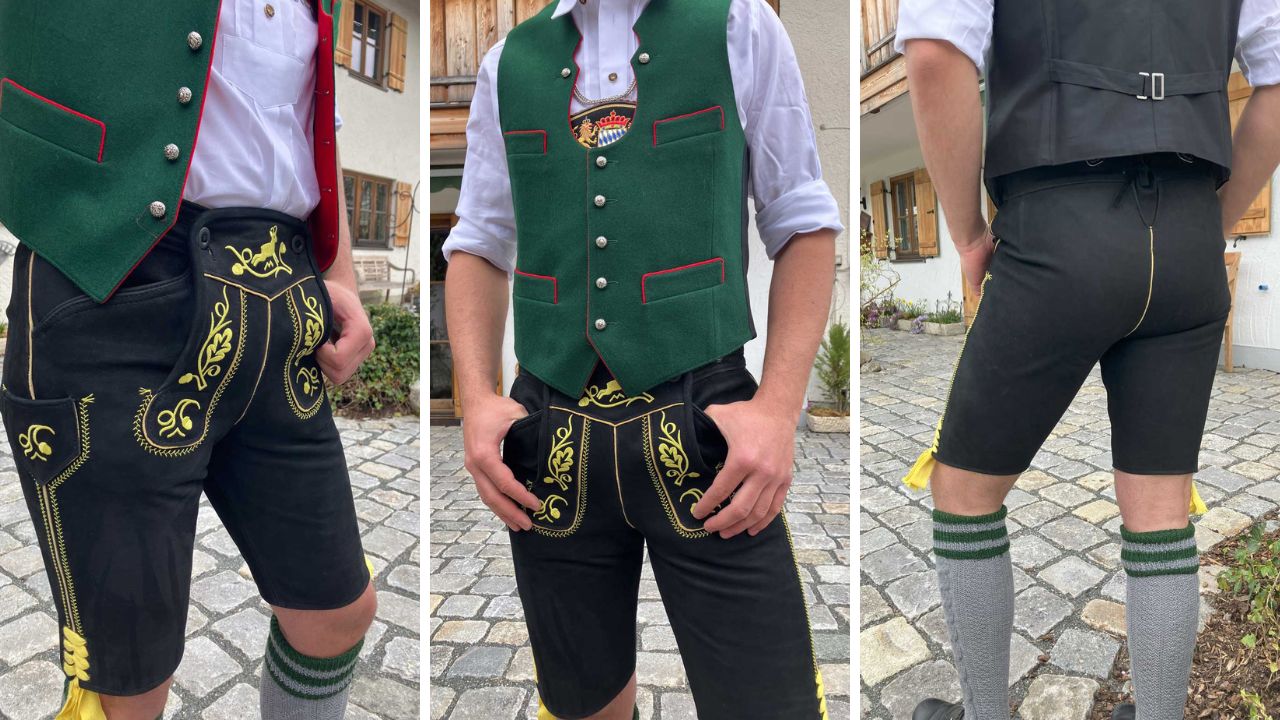
What are Lederhosen? The short answer
Lederhosen are traditional leather trousers worn in the Alpine regions of southern Germany, Austria and South Tyrol. They are typically made from deer, goat or cow leather, fastened with a front flap, held up by braces, and decorated with embroidery. Once rugged workwear for farmers and hunters, they are now worn as festive and formal regional dress, most famously at Oktoberfest.
Key takeaways
- Lederhosen are traditional leather trousers from the Alpine regions of Bavaria, Austria and South Tyrol, usually worn with braces.
- They come in three main lengths: short, knee-length and full-length, each suited to different occasions.
- A genuine pair is defined by its parts: a front flap, braces with a chest bridge, a knife pocket, embroidery and horn buttons.
- Real Lederhosen are made from deer, goat or cow leather and can last for decades. Costume versions use fake leather, printed embroidery and Velcro.
- Today they are worn at Oktoberfest, weddings, folk festivals and traditional dance, and as genuine formal dress in parts of Bavaria and Austria.
What does the word “Lederhosen” mean?
The literal translation
The word combines two German nouns: Leder, meaning leather, and Hose, meaning trousers. Lederhosen therefore translates directly as “leather trousers.” The name describes the material, not the length, which is why the same word covers short, knee-length and full-length styles.
Lederhose or Lederhosen?
In German, a single pair is die Lederhose, in the singular. German treats trousers as one garment, not as a pair. Lederhosen is technically the plural, so a German speaker who hears “my Lederhosen” may assume you own more than one pair. English speakers use Lederhosen for a single pair, and that usage is now standard in British and American English.
Krachlederne and other Bavarian names
In Bavaria you will also hear Krachlederne, a dialect word that loosely means “cracking leather.” It refers to short Lederhosen and to the sharp sound leather makes when slapped during traditional dances. A knee-length pair is called a Kniebundhose or Kniebundlederhose, and older speakers sometimes simply say die Kurze, “the short one.”
How to pronounce Lederhosen
The standard pronunciation is LAY-der-hoh-zen. The first syllable rhymes with “day,” the “s” is soft like a “z,” and the stress falls on the first syllable.
Where do Lederhosen come from?
Lederhosen began as practical workwear in the Alps. Leather was hard-wearing, easy to repair, and far better suited than woven cloth to farm labour, forestry and hunting in steep terrain. Over time the garment moved from the working population into regional festive dress, helped along in the nineteenth century by Bavarian royal patronage of traditional costume and by the Trachten preservation movement, whose first association was founded in Bayrischzell in 1883.
The garment’s journey from peasant clothing to national symbol, including its near-disappearance and revival, is covered in full in our history of Lederhosen.
The parts of a pair of Lederhosen
Understanding the anatomy of Lederhosen is the fastest way to tell a well-made pair from an imitation. Every traditional element once had a practical job.
| Part (German) | English name | What it is | Original purpose |
|---|---|---|---|
| Hosenlatz | Front flap | A drop-down panel across the front, fastened with buttons at the waistband | A durable closure with no zip to break or rust |
| Hosenträger | Braces | Leather straps running over the shoulders, usually in an H shape | Holding heavy leather trousers up during physical work |
| Steg | Chest bridge | The horizontal crosspiece connecting the braces across the chest | Stopping the braces from slipping; became the main space for decoration |
| Messertasche | Knife pocket | A narrow pocket on the outer right thigh | Carrying a traditional Trachten knife for eating and work |
| Seitentaschen | Side pockets | Slanted pockets at the hips, often with stitched edges | Everyday carrying |
| Stickerei | Embroidery | Decorative stitching on the legs, flap and chest bridge | Reinforcing seams and, later, showing regional identity |
| Beinschnürung | Leg lacing | Laces or small straps at the leg openings | Adjusting the fit around the thigh or below the knee |
| Hirschhornknöpfe | Horn buttons | Buttons carved from deer antler or horn | Strong, natural fastenings that last as long as the leather |
Types of Lederhosen
Types by length
| Type | German name | Where it ends | Typical use | Worn with |
|---|---|---|---|---|
| Short | Kurze Lederhose, Krachlederne | Mid-thigh to just above the knee | Summer festivals, Oktoberfest, beer gardens, dancing | Loferl calf warmers or ankle socks |
| Knee-length | Kniebundhose, Kniebundlederhose | Just below the knee, closed with lacing or a buckle | Formal occasions, weddings, church, cooler weather | Long knee socks |
| Full-length | Lange Lederhose | Ankle | Autumn and winter, everyday rural wear, hunting | Regular socks and boots |
Knee-length Lederhosen are generally regarded as the more formal choice, while short Lederhosen are the classic festival garment. Our Lederhosen collection and Kniebundhosen range are organised along these same lines.
Types by cut
Traditional Lederhosen have a relatively straight leg and a high waist that sits comfortably under braces. Modern cuts are slimmer through the thigh, sit slightly lower on the hip, and are often designed to be worn with or without braces. Neither is more “correct,” but members of traditional costume associations tend to favour the classic cut, while younger festival-goers often prefer the modern silhouette.
Lederhosen for women and children
Lederhosen were historically a men’s garment, and the Dirndl remains the traditional choice for women. Women did wear leather trousers for alpine work and hiking during the twentieth century, however, and women’s cuts are now widely made, usually shorter and more fitted at the hip. Children’s Lederhosen are a long-standing tradition in Bavaria and Austria, where many families hand them down between siblings.
What leather are Lederhosen made from?
The leather determines how a pair feels, how it ages and what it costs. Here is the short version:
| Leather | Feel | Durability | Price tier |
|---|---|---|---|
| Deer (Hirschleder) | Very soft and supple | Excellent; ages beautifully | Premium |
| Goat (Ziegenleder) | Soft and lightweight | Very good | Mid to upper |
| Cow (Rindleder) | Firmer and heavier | Very good once broken in | Entry to mid |
| Faux leather or suede-effect fabric | Plastic or textile | Poor | Costume only |
Tanning methods, suede versus smooth finishes and how each hide performs over time are explained in detail in what Lederhosen are made from.
Regional styles of Lederhosen
Lederhosen are not exclusively Bavarian. The City of Munich’s official Oktoberfest website points out that Austrians, Swiss and South Tyroleans wear them too. The garment is shared across the Alpine region, and the differences between areas show up in the details rather than the basic design.
| Region | What varies |
|---|---|
| Upper Bavaria | The best-known style internationally; short and knee-length pairs both common, with rich embroidery on the chest bridge |
| Austria (Tyrol, Salzburg and neighbouring regions) | Local embroidery motifs, colours and brace designs, often closely tied to the valley or village |
| South Tyrol (Italy) | German-speaking Alpine traditions preserved within Italy, with their own costume associations |
| Alpine Switzerland | Worn less widely, mainly in German-speaking mountain areas |
Within each region, traditional costume associations (Trachtenvereine) often define a specific local version, known as the Vereinstracht, down to the embroidery colour and the pattern on the chest bridge. Common embroidery motifs across the Alps include oak leaves, edelweiss, gentian, stags and hunting scenes.
What do you wear with Lederhosen?
Lederhosen are the centrepiece of an outfit, not the whole of it. A complete traditional look includes:
| Item | German name | Notes |
|---|---|---|
| Shirt | Trachtenhemd | Cotton or linen, usually white or checked in red, blue or green. See our Trachten shirts. |
| Waistcoat | Trachtenweste, Gilet | Adds formality; worn over the shirt and under or instead of a jacket. See our waistcoats. |
| Jacket | Janker | A wool or loden jacket for cooler weather and formal events |
| Socks | Loferl, Wadlstrümpfe, Kniestrümpfe | Two-piece calf warmers with short Lederhosen; knee socks with Kniebundhosen |
| Shoes | Haferlschuhe | Sturdy leather shoes with a side lacing, the classic partner for every length |
| Belt | Ranzen | A wide, often embroidered leather belt, sometimes worn instead of braces |
| Hat | Trachtenhut | Felt hat, sometimes decorated with a Gamsbart tuft |
| Chain | Charivari | A silver chain hung with charms, coins or animal teeth, worn at the waist |
Socks, shoes, belts, braces and hats can be found in our Trachten accessories.
When and where are Lederhosen worn today?
Oktoberfest and folk festivals
Oktoberfest in Munich is the most famous setting for Lederhosen, and a large share of visitors now arrive in traditional dress. The same is true of the many smaller Volksfeste held across Bavaria and Austria throughout the year, as well as the Oktoberfest-style events that have spread to the UK, the US and beyond.
Weddings, church and formal events
In Bavaria and Austria, Lederhosen, especially knee-length pairs, are accepted as formal wear. Grooms and guests wear them at weddings, and they appear at christenings, harvest festivals and civic events. This was not always the case: according to the official Oktoberfest website, the Archbishop of Munich declared Lederhosen immoral in 1913, and they are still frowned upon in some churches during services.
Traditional dance and costume associations
Lederhosen are essential for the Schuhplattler, the Bavarian and Tyrolean folk dance in which men slap their thighs, knees and shoe soles in rhythm. Members of Trachtenvereine wear their association’s specific costume at parades, dances and processions, keeping regional styles alive.
Everyday rural wear
In parts of rural Bavaria and Austria, older men still wear Lederhosen for gardening, farm work and hiking. This is the garment’s original purpose, and a well-worn pair used this way is regarded with more respect than a pristine one.
How should Lederhosen fit?
Lederhosen should feel snug but never pinch. Leather relaxes and moulds to the body with wear, so a new pair should fit slightly tighter than you would choose for fabric trousers. The waist and seat matter most, and the leg openings should sit close without restricting movement. Step-by-step measuring instructions are in our guide on how to measure for Lederhosen, and our size guide converts those measurements into sizes. If your measurements fall between standard sizes, made-to-measure Lederhosen give you a fit built around your body.
Authentic Lederhosen vs costume Lederhosen
The word Lederhosen is printed on everything from hand-stitched deerskin heirlooms to polyester party outfits. These are the differences that matter.
| Feature | Authentic Lederhosen | Costume Lederhosen |
|---|---|---|
| Material | Genuine deer, goat or cow leather | Polyester, faux suede or coated fabric |
| Front closure | Buttoned front flap | Velcro, press studs or a printed flap |
| Embroidery | Stitched by hand or machine into the leather | Printed, heat-transferred or glued on |
| Buttons | Horn or antler | Plastic |
| Braces | Leather, with a structured chest bridge | Fabric or thin vinyl, often elasticated |
| Seams | Strong, even stitching with reinforced stress points | Light stitching that fails under strain |
| Smell and feel | Natural leather scent; softens with wear | Chemical smell; stiff or shiny |
| Lifespan | Decades with basic care | One or two events |
A simple rule: if you can see Velcro, it is a costume. Genuine Lederhosen are built to be worn, repaired and worn again, and a well-made pair should outlast every other item in the outfit.
Where Lederhosen are made today
Lederhosen production is now a global industry. The official Oktoberfest website notes that many factories are located in India, Hungary and Sri Lanka, and that the leather often comes from Pakistan or New Zealand. Pairs made entirely from domestic deer leather by traditional Bavarian workshops exist, but they cost considerably more. Where a pair is made tells you less than how it is made, which is why the leather, stitching and hardware in the table above are the real quality markers. To see what goes into cutting, stitching and embroidering a pair, read how Lederhosen are made.
How long do Lederhosen last?
A good pair of leather Lederhosen can last a lifetime, and in Bavaria they are often passed from father to son. Leather develops a patina with wear, darkening at the thighs and seat and softening throughout. Many owners consider an aged pair more desirable than a new one, which is why washing is traditionally avoided. Brushing off dirt, airing the leather after wear and storing it somewhere dry is usually all the care a pair needs, with occasional professional leather cleaning for heavy stains.
Myths and curious facts about Lederhosen
- Underwear was once optional. The official Oktoberfest website notes that until the 1940s Lederhosen were commonly worn with nothing underneath. Today it is a matter of personal preference, though the close fit leaves little room for bulky underwear.
- They are not just for Oktoberfest. Lederhosen predate Oktoberfest as working clothes and are worn year-round in Alpine regions.
- They handle rain and spilt beer well. Leather tolerates liquids better than most people expect, one reason the garment is sometimes described as early functional clothing.
- There is a village called Lederhose. It sits in Thuringia, near the A9 motorway south of Leipzig.
- Hamburg’s police wear leather trousers. The city’s police dog handlers traditionally wear leather rather than cloth trousers on duty, a practical rather than folkloric choice.
Frequently asked questions
Are Lederhosen German or Austrian?
Both. Lederhosen belong to the shared Alpine tradition of Bavaria in Germany, Austria and South Tyrol in Italy. Bavaria is the best-known home of the garment internationally, largely because of Oktoberfest.
Are Lederhosen shorts or trousers?
Either. Lederhosen simply means leather trousers, and the name covers short, knee-length and full-length styles. In English, the short version is the most familiar image.
Can women wear Lederhosen?
Yes. Although the Dirndl is the traditional women’s garment, women’s Lederhosen are widely worn at festivals and are made in cuts designed for the female figure.
Why are real Lederhosen so expensive?
Genuine leather, dense embroidery and skilled construction all take time and material. A premium deerskin pair with hand embroidery requires many hours of work, but it can last decades, which makes its cost per wear lower than that of repeatedly replacing costume versions.
Is it disrespectful for non-Germans to wear Lederhosen?
No. Visitors in Lederhosen are a welcome and familiar sight at Oktoberfest and other festivals. What locals tend to dislike is cheap, novelty or sexualised costume versions, not people from elsewhere wearing traditional dress properly.
Are Lederhosen comfortable?
A well-fitting leather pair becomes very comfortable once broken in, because the leather softens and shapes itself to the wearer. New pairs can feel stiff for the first few wears, especially cow leather.
Can you wear Lederhosen without braces?
Yes, particularly modern cuts designed to sit on the hip, which can be worn with a belt. Traditional high-waisted pairs look and fit best with braces.
What is the difference between Lederhosen and Bundhosen?
Bundhosen, or Kniebundhosen, are a type of Lederhosen that end just below the knee and fasten there with laces or a buckle. All Kniebundhosen are Lederhosen, but not all Lederhosen are Kniebundhosen.
The bottom line
Lederhosen are Alpine leather trousers that began as tough workwear and became one of the most recognisable forms of traditional dress in the world. What makes a pair genuine is not the label but the construction: real leather, a buttoned front flap, proper braces with a chest bridge, stitched embroidery and horn buttons. Choose the length for the occasion, get the fit right, and a good pair will serve you for decades, getting better every time you wear it.

Anna Bauer is a seasoned Bavarian fashion expert, cultural consultant, and heritage stylist with over a decade of hands-on experience in traditional German clothing. Born in Munich, the heart of Bavaria, Anna grew up surrounded by the rich traditions of Trachten fashion. Her passion for cultural attire led her to pursue a degree in Fashion and Textile Design at the prestigious University of the Arts Berlin, where she specialized in European folkwear.
Over the past 12+ years, Anna has collaborated with renowned Trachten designers, styled outfits for Oktoberfest events across Germany, and contributed articles to top fashion and culture magazines across Europe. Her work focuses on preserving the authenticity of Lederhosen and Dirndl wear while helping modern audiences style them with confidence and flair.
As the lead content contributor for German Attire, Anna combines her academic background, professional styling experience, and deep cultural roots to provide readers with valuable insights into traditional German fashion. Her blog posts cover everything from historical origins and styling guides to care tips and festival outfit planning—making her a trusted voice for anyone looking to embrace Bavarian heritage in a stylish, modern way.