Get 5% Off – Use promo code German Attire


Gingham vs Plaid vs Tartan vs Check: What Is the Difference?
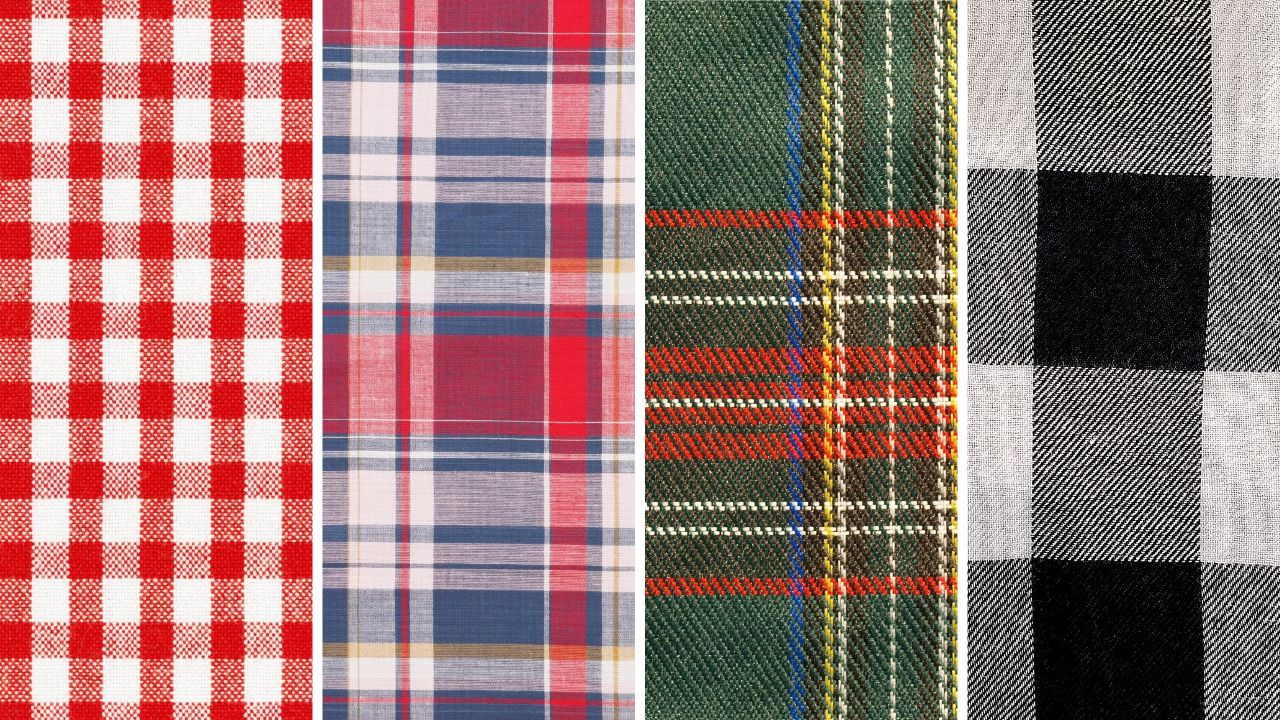
Gingham vs Plaid vs Tartan vs Check: What Is the Difference?
Check is the umbrella term for any pattern of crossing horizontal and vertical bands. Gingham is a check in two colours with equal squares. Tartan is a Scottish check in several colours with bands of varying width, arranged in a repeating sequence called a sett. Plaid means different things in Britain and America, which is the main reason people find this confusing.
If you only remember one test: count the colours and look at the band widths. Two colours with identical squares means gingham. Three or more colours with bands of different widths means tartan.
Why this is so confusing: plaid means two different things
Most articles on this subject pick one definition of plaid and treat it as the only correct one. That is why readers come away more confused than when they started. There are genuinely two usages in current English, and both are legitimate within their own region.
What plaid originally meant
Plaid is not a pattern word at all in its original sense. It comes from the Scottish Gaelic plaide, meaning blanket, and it was first recorded in that sense around 1505 to 1512. By the 1510s the English word described a garment: a long rectangular piece of woollen cloth worn draped over the body in Scotland, often but not necessarily in a tartan pattern.
That meaning is still alive. In Scotland today, a plaid is a garment rather than a design. The belted plaid was the ancestor of the modern kilt. The fly plaid is the smaller cloth pinned at the shoulder with Highland dress. The arisaid was the women’s equivalent. In each case the word refers to the piece of cloth, not to the checks printed or woven on it.
What plaid means in North America
American English took the word in a different direction. In the United States and Canada, plaid describes the pattern itself, and is used more or less interchangeably with tartan. It also stretches further than tartan does, covering any crisscross design, so a two-colour check shirt is commonly called plaid in North America even though it has no connection to Scotland.
So which is right?
Both, depending on who you are talking to. This is a regional difference in usage, not a case of one group being wrong.
The practical consequence matters if you shop online. A shirt listed as “plaid” on an American site may be anything from a tartan to a simple two-colour check. The same shirt on a British site is more likely to be called checked, and the word plaid is more likely to appear in a Highland dress context. When you are buying, ignore the label and look at the pattern itself using the tests below.
Check is the umbrella term
The word that actually covers all of these is check. A check is any pattern formed by crossing horizontal and vertical bands, and every pattern in this article is a type of check.
Two related words cause minor trouble. Checked is the standard adjective in British English, as in a checked shirt. Checkered, spelled chequered in Britain, is more often used for the large two-colour squares of a chessboard, as in a chequered flag. In everyday speech people use them interchangeably, and in a shopping context they mean the same thing.
In German-speaking countries, where most traditional Trachten shirts are made, the equivalent word is Karo. A checked Trachten shirt is a Karohemd, and gingham specifically is Vichy-Karo.
The identification table
This is the fastest way to place any checked fabric.
| Pattern | Colours | Band widths | Scale | The giveaway |
|---|---|---|---|---|
| Gingham | Two, one usually white | All identical | Small, typically 3 to 12 mm | Three visible tones from two yarn colours |
| Tartan | Three or more | Varied, in a repeating sett | Medium to large | Diagonal twill weave lines and uneven band widths |
| Buffalo check | Two, classically red and black | Identical | Large, roughly 4 to 15 cm | Gingham logic at four times the size, with no white |
| Tattersall | Two line colours on a plain ground | Thin lines, evenly spaced | Medium | Most of the cloth stays undyed; lines rather than blocks |
| Windowpane | One line colour on a plain ground | Single thin lines, widely spaced | Large | Looks like a grid drawn on plain fabric |
| Madras | Many, often bright | Irregular and uneven | Medium to large | Deliberately imperfect, handwoven look |
How to identify each pattern
Gingham
Two yarn colours, one of them almost always white, woven into squares of exactly equal size. The quickest confirmation is to count the tones: because the coloured yarn crosses both white and itself, a red gingham shows white, red and pale pink rather than just two flats. Our full guide explains what gingham is and how the weave produces that effect.
Gingham is small. If the squares are bigger than about a centimetre and a half, you are probably looking at buffalo check instead.
Tartan
Tartan is the Scottish pattern, known in Gaelic as breacan. It uses crossing bands in multiple colours, and the crucial point is that the bands are of different widths, arranged in a fixed repeating sequence known as a sett. Designs range from simple two-colour arrangements to intricate patterns using more than twenty shades.
Two further markers separate tartan from a generic multicolour check. First, traditional tartan is woven in twill rather than plain weave, which produces visible diagonal lines running through the cloth. Second, individual tartans are named and recorded, many of them associated with particular clans, districts or organisations, and the Scottish Register of Tartans exists specifically to document them.
A multicolour check with no name and no sett is not a tartan. It is simply a check.
Buffalo check
Buffalo check is structurally very close to gingham, scaled up dramatically and usually without white. The classic version is red and black in large blocks. Gingham squares are typically under a quarter of an inch; buffalo check runs from about an inch and a half up to six inches.
Its history is American rather than Scottish, although it began as a copy. The pattern was introduced at the Woolrich mill in Pennsylvania around 1850, imitating a Scottish check known as Rob Roy, and the usual explanation for the name is that the designer owned a herd of buffalo. That story is repeated by the company itself but flagged as legend rather than documented fact, so treat it as a good story rather than a certainty. What is well established is that the pattern became the uniform of Pennsylvania lumberjacks and then a fixture of American outdoor clothing.
Tattersall
Tattersall consists of thin lines in two alternating colours running over a plain, usually pale, ground. The distinguishing feature is that most of the fabric remains undyed. Where gingham and buffalo check fill the cloth with blocks of colour, tattersall draws a grid on top of it.
The name comes from Tattersall’s horse market in London, founded in 1766, where blankets in this pattern were sold during the eighteenth century. The equestrian association survives: tattersall shirts remain standard in formal riding dress and in British country clothing.
Windowpane
Windowpane is the simplest of all. Single thin lines, widely spaced, forming large open squares on plain cloth. Only one line colour is used, which is what separates it from tattersall. It is a tailoring pattern more than a shirting one, common on suits and jackets, and it reads as quietly formal.
Madras
Madras takes its name from the Indian city now called Chennai. It is a lightweight cotton in bright multicoloured checks and stripes, and unlike everything else on this list its irregularity is the point. Bands are uneven, colours are unevenly distributed, and traditional vegetable-dyed versions were sold as “bleeding madras” because the colours ran and softened with each wash.
If a check looks colourful, slightly chaotic and summery, it is probably madras.
Others you will meet
Houndstooth is not really a check at all but a broken check, made of small jagged four-pointed shapes, known in French as pied-de-poule. Glen plaid, properly Glenurquhart check, combines small and large checks in muted tones and is called Prince of Wales check when an overcheck in a contrasting colour is added. Both are tailoring patterns rather than shirting patterns.
How to tell them apart in ten seconds
Work through these in order and you will place almost any checked fabric correctly.
- Is most of the cloth plain, with only thin lines crossing it? If yes, it is tattersall (two line colours) or windowpane (one).
- Count the colours. Three or more means tartan or madras. Two means gingham or buffalo check.
- If three or more, look at the band widths. Regular and repeating in a fixed sequence means tartan. Irregular and bright means madras.
- If two, look at the size. Small squares with a white component mean gingham. Large blocks, often red and black, mean buffalo check.
- Still unsure between gingham and printed imitation? Turn the fabric over. Woven gingham looks identical on the reverse.
Which checks belong in Trachten
This is where most comparison articles stop being useful. Knowing the names does not tell you what to actually wear with Lederhosen or a Dirndl.
| Pattern | Suitable for Trachten? | Why |
|---|---|---|
| Gingham | Yes, the standard | The traditional Bavarian shirt pattern in red, blue or green |
| Small two-colour check | Yes | Effectively gingham; the everyday Alpine shirt |
| Tattersall | Occasionally | Reads as British country dress rather than Bavarian, but works on a subdued Trachten shirt |
| Tartan | No | Unmistakably Scottish; mixes two unrelated traditions |
| Buffalo check | No | Reads as American lumberjack, not Alpine |
| Madras | No | Wrong colour language entirely |
| Windowpane | Rarely | A tailoring pattern; occasionally seen on Trachten jackets |
The rule behind the table is simple. Bavarian Trachten shirting settled on the two-colour check because that was the cheap, hard-wearing cotton available to Alpine working people in the nineteenth century. Patterns that developed elsewhere, for other reasons, look out of place however good the garment is.
What this means when you are buying
Three practical points follow.
Buy by the pattern, not the label. Online listings use plaid, check and checkered loosely and inconsistently, especially across American and British sites. Look at the photograph and apply the ten-second test above.
For Trachten, stay with the two-colour check. Red and white is the most recognisably Bavarian, as in the Regensburg red gingham or the Passau red check. Blue and white carries the Bavarian state colours, which we cover in our guide to the Bavarian Raute, and appears in the Rosenheim blue gingham. Green and white belongs to the hunting and forestry tradition, as in the Garmisch forest check. The full range sits in our men’s Trachten shirts and women’s Oktoberfest shirts.
Wear one check at a time. A checked shirt with Lederhosen and an embroidered waistcoat works, because embroidery is a motif rather than a competing pattern. Two different checks in one outfit do not. The same applies to a Dirndl: if the apron is patterned, keep the blouse plain.
If you are assembling a full outfit for the first time, our guide to what Lederhosen are explains how the pieces fit together.
Frequently asked questions
Is gingham a plaid?
In American English, yes, because plaid is used there for any crisscross pattern. In British English, no, because plaid refers to Scottish cloth and Highland garments. The pattern itself is unambiguous either way: gingham is two colours in equal squares.
What is the difference between plaid and tartan?
Tartan is a pattern of crossing bands in several colours arranged in a repeating sett, and individual tartans are named and recorded. Plaid originally meant a garment made from such cloth, and in North America now means the pattern itself. In Scotland, plaid still usually refers to the garment.
Is gingham the same as checkered?
Gingham is one kind of check. Checkered, or chequered in British spelling, is a general word for any pattern of squares and is often used for large two-colour squares like a chessboard. All gingham is checked; not all checks are gingham.
What is the difference between gingham and buffalo check?
Scale and colour. Gingham squares are typically under a quarter of an inch and include white. Buffalo check runs from about an inch and a half to six inches and is classically red and black with no white.
Is buffalo check a tartan?
Not in the Scottish sense, although it was copied from one. The Woolrich mill based it on a Scottish check known as Rob Roy around 1850, but the American version is not a registered tartan and carries no clan association.
What is the difference between gingham and tattersall?
Gingham fills the fabric with blocks of colour. Tattersall leaves most of the fabric plain and draws thin lines across it in two alternating colours.
Why is it called tattersall?
After Tattersall’s horse market in London, founded in 1766, where horse blankets in this pattern were sold during the eighteenth century.
Can you wear tartan to Oktoberfest?
You can, but it will read as Scottish rather than Bavarian. Traditional Trachten shirting is a two-colour check in red, blue or green, and that is what locals wear.
What is a check called in German?
Karo. A checked shirt is a Karohemd, and gingham in particular is called Vichy-Karo, after the French town of Vichy.
Which check is the most formal?
Among shirtings, a micro gingham or a fine tattersall reads as most formal, because the pattern almost disappears at conversational distance. Large checks of any kind read as casual.
The bottom line
The confusion around these patterns is mostly a language problem rather than a visual one. Once you know that plaid means a garment in Scotland and a pattern in America, and that check is the umbrella term covering all of them, the fabrics themselves are easy to tell apart.
Count the colours, look at the band widths, judge the scale. Two colours and equal small squares is gingham, and for Bavarian Trachten that is the one that matters.
Related reading: what gingham is, the Bavarian Raute pattern and the edelweiss motif.

Bavarian heritage and fashion specialist · Lead content
contributor, German Attire
About Anna
Anna Bauer grew up in Munich, where traditional dress is not a costume but everyday formal wear. Trachten appears at weddings, at church, at village festivals and in public life, and that ordinary familiarity shapes how she writes about it. She studied fashion and textile design at the Berlin University of the Arts, specialising in European folkwear. Over more than a decade since, she has worked with Trachten designers and styled outfits for Oktoberfest events across Germany.
What she writes about
- The history and regional variation of Bavarian and Alpine dress
- How Dirndl and Lederhosen are constructed, and what separates
authentic garments from costume versions - Fabric patterns and embroidery motifs, and what they mean
- Styling traditional dress for festivals, weddings and formal
occasions - Fit, sizing and care
Her approach
Anna’s writing starts from a simple position: traditional dress deserves to be explained accurately. Much of the English-language information about Lederhosen and Dirndl repeats claims that no Bavarian would recognise. Her work aims to correct that, and to give readers outside Germany enough context to wear Trachten with confidence rather than guesswork.